

In late 2021 our small church of about 50 people began making a transition from Sunday morning worship services and monthly home groups, to restructuring ourselves around the concept of “church as an extended family network.” This meant that we formed three neighborhood-based churches who began meeting weekly in homes for the challenging, but critical, process of interpreting our lives through the gospel, using the apostles’ teaching, structured around a meal and a discussion time.
These changes were the result of a long process involving decades of intentional shepherding across a succession of one-minded leaders, each one carrying forward the work of the previous. In 2002, for a brief moment when all four of these leaders were present in the situation together, we recognized the need to move in the direction of gathering weekly in homes around a meal and discussion, even though we had not yet understood the critical nature of organizing ourselves as a network of small neighborhood-based churches who function as an extended family. That would come later.
In our efforts to avoid harming any of those who we were responsible for before Christ, we adopted a strategy to carefully shepherd the church in this direction, recognizing that making too many changes, too quickly, could result in a destabilization of the entire effort and inadvertently defund the livelihoods of the very leaders who were working to shape this church as a family.
By the time the baton was passed to me in 2021, enough progress had been made that I was able to accelerate the process. This was due to several factors. First, by that time many in the church had embraced the ideas and had a genuine commitment to one another. Others had either retired, moved away, or were at a stage of life where they were dependent on us and willing to follow our lead. And lastly, but very significantly, my income was not tied to holding an official position in the church. All of this freed me to be more aggressive with paradigm transformation.
But even then, we were not instantly successful. Families I thought would easily grasp the value of these changes (even some families I thought would help lead the way for others) floundered, complained, disengaged and a few even left and went elsewhere. After about three years of gathering this way, we had lost two key families plus a few others on their coattails. But we stuck with it and leaned on other churches in our network to help us process these losses and keep moving forward with resolve. Also, the First Principles Series, which we had been studying as a church for two decades, began coming alive for us in ways we hadn’t anticipated. This series, which is organized around the key church-establishing concepts from Paul’s early, middle, and later letters, had been living in our heads, but we had been filtering the concepts through our old church traditions. It wasn’t until we began gathering as families, in homes, around a weekly meal and conversation that the reality of the teaching that Paul delivered became clear and meaningful.
But as we made these changes, a new set of challenges began to arise, and we realized that truly being a family together required a different level of commitment, a new set of habits, and a new leadership structure. Gone were the days where a pastor and a worship leader were sufficient to pull off a Sunday event for 150 people. Now, each gathering needed a shepherding leader and each cluster needed an elder. Fewer people required more well-trained leaders and a serious commitment from everyone in order to pull off successful gatherings in our homes; AND it required all of us to engage in meaningful dialogue around the gospel and its implications and regular “one-anothering” throughout the week. We had come to understand that this is what it looks like to truly be a family together.
We were now able to assess the remaining traces of institutionalism that were holding us back from fully functioning as a family. Many of these related to the organizational structure of our church, the framework of which had been laid in the 1940’s. Those founding documents dictated institutional oversight and management structures, meaning, we were a Senior Pastor-facilitated, congregationally led organization, rather than a well-shepherded, apostolically led church network. It was time to address this next set of issues.
That meant overhauling our founding documents to reflect the reality we were all committing our lives to. It wasn’t just about updating these documents to fit a new leader or leadership style, but completely reorienting them around the paradigm of The Way of Christ and His Apostles (1 Cor 4:16-17; Heb 10:1-20.) New Jersey requires churches to maintain a Constitution and Bylaws and a Board of Trustees, so I still had to work within that cultural system, but I also needed the end result to reflect Christ’s design for His church. The most revolutionary aspect of that overhaul was the elimination of a democratic hierarchy where the congregation voted on “elder” recommendations and employed pastors to perform religious services. Instead, those documents needed to reflect the two-fold leadership structure from the New Testament, made up of apostolic (sodality) leaders — so that the church could fully engage in our stewardship of becoming a hub situation like Ephesus1 in partnership with a larger North American apostolic team; and shepherding (modality) leaders who would help these churches and clusters shape every aspect of their lives around the gospel, allowing them to become a cluster of churches that function together as a kerygmatic community2, becoming a support-base for the progress of the gospel across our region, throughout our slice of the world, and from network-to-network around the globe.
What does this overlapping, sodal-modal leadership structure look like? Something like this:
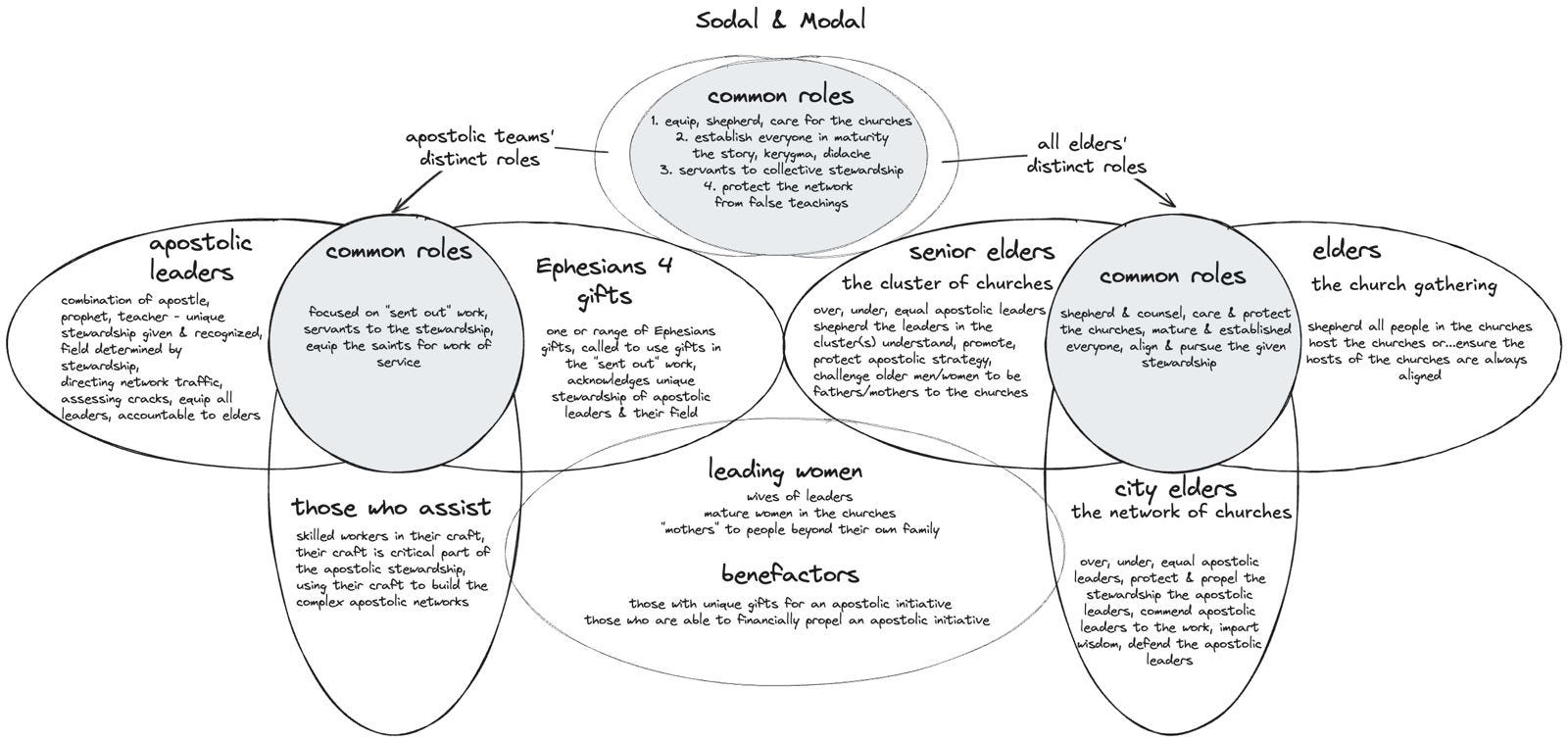
Chart by Michael Vos
One question I consistently get from those outside looking in, is how we maintain accountability in a church with no senior pastor or board of trustees. My answer is that we do have trustees, but they aren’t businessmen running an organization, they are apostolic leaders setting the direction of the church and challenging our churches to fulfill our shared stewardship. And we do have shepherding (pastoral) leaders, but they aren’t professional preachers or paid administrators, they are mature couples “parenting” a household of households (cluster of churches.) These questions tend to originate from others who are still in institutional church situations, and are mainly interested in matters of fiscal accountability and preventing a single leader from having too much power. Their approach and focus are on creating financially successful institutions with a balance of power, not on maturing households and training leaders for the progress of the gospel.
Below is a continuum showing how accountability works within communities and trust networks, and how both rigid institutional settings and dynamic movements can tend toward unhelpful extremes. As you can see, Christ’s plan for building communities is not without accountability, but it also is not based on institutional hierarchies.
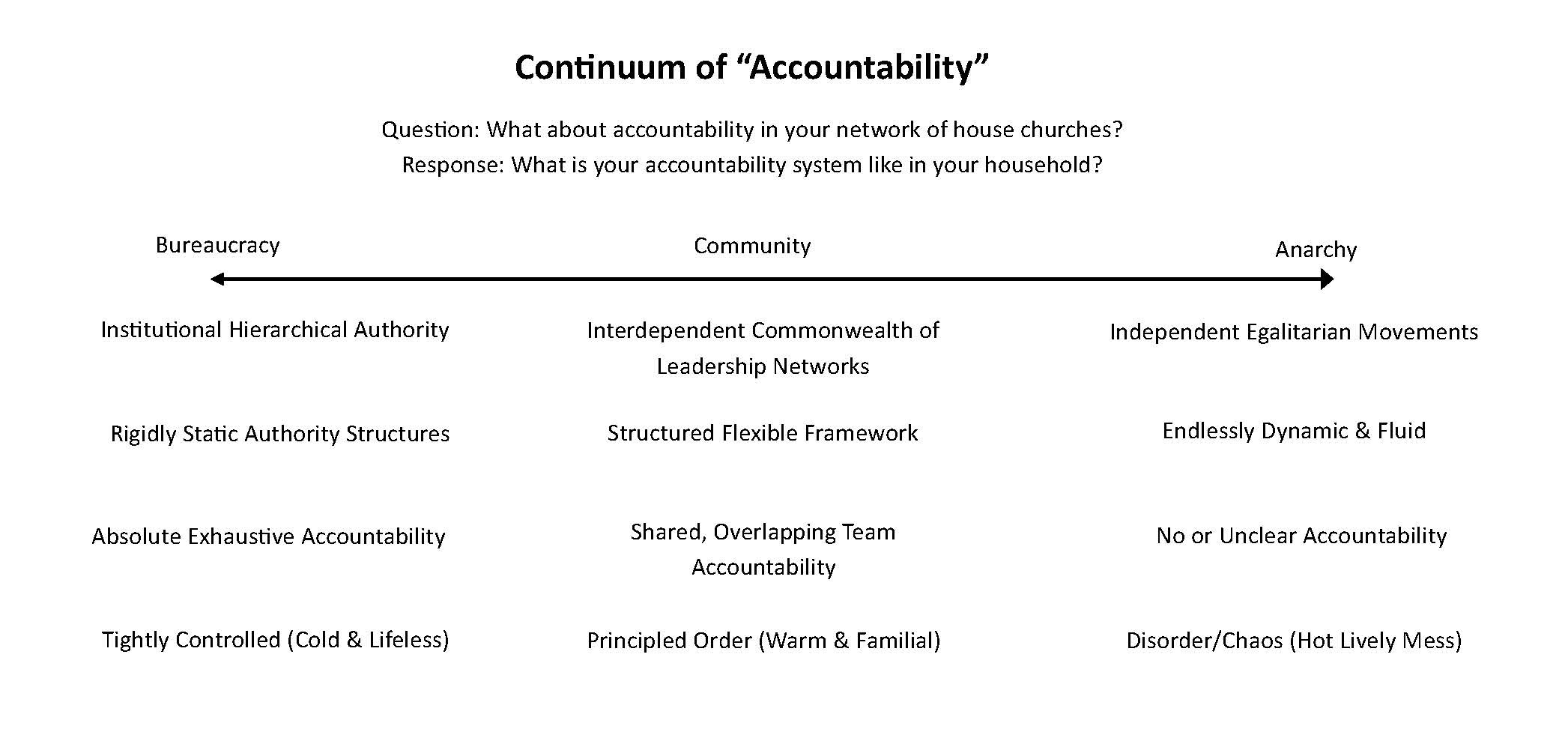
We are continuing the process of orienting our lives together around Christ’s grand strategy (Eph 3:8-12) and we will continue shaping our lives around Jesus’ new covenant system and working with other churches and networks to shape a one-minded movement around the way of Christ and His apostles.
Here’s a boiled-down set of steps for how leaders can restructure their traditional churches to become a genuine community.
If you are not part of a complex apostolic network , then find an apostolic team and attach yourselves to them. They will provide the support, direction, and assessment you will need to stick with this and make progress.
In your own church situation, invest heavily in couples who have stable, well-ordered households, especially those who have natural shepherding gifts. Help them become clear thinkers and confident teachers.
[All leaders currently functioning as paid staff should begin investigating how to build a portfolio of flexible paid work options, so that they become less dependent on the church for their income. Apostolic leaders should pursue self-enterprising work as a stabilizer, but should have a base church or small network of base churches who support their work. Elders should pursue flexible income streams so that they are freed up to engage deeply in family-life alongside other households in the churches, modeling this well for others.]
Begin getting everyone engaged in one-anothering as a life orientation, developing a new set of community habits together.
Begin laying foundations by carefully teaching through the TWCA framework to develop one-mindedness. This should be approached from the desire to nurture everyone along, but you should also be ready to do battle when necessary, particularly around strong commitments to secondary traditions, which many will struggle to let go of; or emotional commitments to popular inspirational movements, which many will struggle to bring into alignment with Christ’s plan.
Create a prototype of a weekly gathering around a meal/conversation, using it as a case study for the entire church (utilizing your existing shepherding leaders from #2.)
Use that prototype alongside an ordered learning process so that households and churches are becoming equipped to fully engage in community life and in their own spheres of influence. This helps drive conversations and incremental change as everyone begins adjusting how they view and practice their gatherings, community life, commitment levels, personal life development, leadership roles, engagement in evangelism & mission, etc.
[Address the critical role of women in pulling off this new way of gathering and being family together. You will not be successful unless everyone begins understanding the critical and strategic role of women in all of this!]
Eventually, begin restructuring your entire church situation around a network concept (family of families - church of churches - cluster of gatherings - network of clusters, network of networks, etc.)
Focus on expansion through multiplication of church communities, rather than solely by adding converts to a single gathering. Once smaller neighborhood-based churches are living well as extended families, some of this growth will begin happening spontaneously, but leaders should also be planning and preparing for intentional, strategic expansion. This type of growth requires more well-trained leaders, but much less infrastructure and much smaller budgets. You will need well-trained leaders, host homes, and an apostolic network partnership.
If you plan to retain your church’s legal organizational status, then devise a plan to officially restructure in a way that simultaneously meets all legal requirements while also reflecting Christ’s household design. Then begin making the paradigm “official” in your legal documentation based on your new practices, reflecting your updated approach to how decision-making happens.
As consensus is gained and critical mass is reached, if necessary, bring things to a congregational vote to turn the old democratic system on its head and fully establish the new team approach, where apostolic leaders and elders regularly and transparently make strategic decisions based on the growing one-mindedness, engaging with the church clusters as true partners in their shared stewardship, while interacting with a broader leadership team of coworkers and shepherding types who have real input.
If the church owns property, reconsider how to utilize that property as a resource to fuel expansion of clusters of church gatherings. It could mean selling or leasing properties to generate resources, or restructuring them to function as community centers that benefit cities and become self-funding (so that they are no longer a drain or encumbrance.)
Engage early and often with the next two generations from the church community. Help them understand the story we are all living in, God’s Story, and its implications, and help them become familiar with the framework of the biblical collections of literature and the intent of the authors, so that they fully orient their lives around their church family within the context of Christ’s Grand Strategy, and thoroughly understand the age in which we are living. Focus on preparing them to lead their generation in the same TWCA tradition, but with a theology-in-culture3 skillfulness.


Scott Canion is based out of the NYC area and is part of the METRO equipping team, a network of leaders who are establishing churches that are families… patterned after Acts.
Network Churches: Hubs, Clusters, Strategic Churches. These refer to the three main kinds of churches that Paul wrote to in his Middle Letters—Ephesians, Colossians, and Philippians—that serve as a snapshot of the three types of churches that made up Paul’s network: Ephesians served as a hub church; Colossians was a small cluster of three churches (Lycus Valley); and Philippians was a strategic partner church.
Kerygmatic Communities. This term refers to the new community that Jesus built, made up of the disciples and those around them after His ascension (Acts 1) and the communities—churches—that eventually multiplied across the Roman Empire; they were kerygmatic in the sense that they were commissioned to continue the proclamation to the entire world.
Theology in Culture. Based on a biblical theology foundation, doing theology in culture is the process and ability to think biblically in culture. It deals with issues that Scripture does not directly address, but which we can confidently address, forming solid answers as a result of increasingly mastering the Scriptures.