


Photo by Jude Al-Safadi on Unsplash
The recent paraphrases I wrote on 1 Corinthians 11:17-14:40 were developed out of a conversation in the churches that I work among to help bring clarity and one-mindedness around what Paul was really saying regarding church gatherings and how those gatherings are both a reflection of and a reminder to live their entire lives together as an extended family.
In one of our recent equipping times with a cluster of these churches (where we were discussing 11:17-34) there was a specific question about a passage that occurs just prior in 11:2-16. The question was about what Paul is saying in this passage regarding women and headcoverings. This led me to go ahead and extend that paraphrase back for these verses.
Below is the paraphrase, and afterward I will comment on the integrated way Paul is addressing the role of women in the church gathering, since there is another difficult passage in 14:33-35 that is impossible to understand outside of grasping Paul’s “no systematic theology” approach to training leaders and establishing church networks.
Note: This is not meant to be a comprehensive addressing of the role of women in the church, but merely a clarification of what Paul was doing with these two passages in question
“Now, while I appreciate that you all remember and still hold to many of the patterns that I passed on to you, you have to be careful not to render them meaningless by the manner in which you practice them. You need to understand that God has a specific household order, rooted in creation, which reflects His wisdom. This involves husbands subjecting themselves to Jesus, wives subjecting themselves to their husbands and Jesus subjecting Himself to the Father. This is already reflected in some aspects of your cultural practices. The cultural norms in your homes/households (the location and context for your gatherings) contain some symbolic practices which reflect and reinforce this household order, and don’t necessarily need to be rejected in order for you to reflect God’s manifold wisdom. Since some of the traditions you already practice dovetail well with Jesus’ household order, you can continue practicing them when you gather. In particular I’m referring to the practice of women covering their heads when they pray or prophesy. You don’t have to abandon this customary practice or try and equalize it by suggesting that men cover their heads. I can still make a pretty good argument from the functional nature of the created order that will support this cultural practice, so why challenge it and unnecessarily upset a cultural tradition that can be helpful in reinforcing the household order? (The household order I delivered to you is the social structure for Jesus’ global family according to the grand strategy He commissioned me to implement.)
My argument goes something like this, the man was made to be the image-bearing glory of God and the woman was made to be the image-bearing glory of mankind. Remember, the introduction to the Torah gives us the foundational narrative that provides us with an understanding of how God’s good world functions best. In that narrative, the woman was made from the essential substance of the man, to help him with the tasks God gave him. (When wives subject themselves to their husbands, it even encourages the spiritual beings in heavenly places - who are watching what is happening in Jesus’ family - to reflect that created order and subject themselves to their creator.) But don’t hold too tightly to one specific symbolic cultural practice, even if they currently seem to reflect this order. After all, every man alive today came from a woman, and everyone was ultimately created by God - who holds all things together.
So you need to be discerning in these things and remain flexible with the symbolic cultural practices you use to represent them. What representations do you think would be proper in your time and culture? Which symbolic practices should you keep, in order to reflect this household order? Which should you let go of?
Whatever you decide, do it carefully, with thought, prayer, community dialogue and a clear connection back to the household tradition I delivered to you, because this household order is absolutely critical for being a one-minded family together. There is no other viable social structure for Jesus’ family, no other tradition. This is the social structure that is to be practiced in all the churches across the entire global movement.
Notice that Paul is not commanding them to continue the practice of headcovering for women. He is training them to think in principles, so that they can engage in practices that take into account their own culture, while still accurately reflecting the household order.
There is another difficult passage in 14:33-35, (which I paraphrased in The Early Church Gathering - Part 3) that I want to address here, in light of the overall principle that is guiding how Paul is talking about the participation of women in the gathering. The key principle being that Jesus’ family (the churches) are to live within His prescribed social structure, which is “household”. There are specifics that need to be understood for how individual households order themselves and participate in the larger extended family (their churches) and how all of these churches are networked together by apostolic-type leaders to form a global family movement… the household of God - which is the pillar and support of the true reality that is the continuation of what God has been doing since the foundation of the earth, through the promises to Abraham’s family, which began to be substantially fulfilled by what Jesus set in motion and commissioned Paul to fully implement. (1 Tim 3:14-16; Eph 3:8-10)
Within this household order, there are gender specific roles, age related roles, and definitions of how to live in our work situations, our cultures, and in subjection to our governments. All of this underpins what Paul addresses in these specific passages that refer to the participation of women in the gatherings. You cannot draw conclusions about women’s participation in the weekly gathering in light of our modern church services, which are the product of fragmentation and professionalization of things that should be a normal part of the community life of local churches. The complimentarian/egalitarian debate has been a distracting rabbit trail for far too long. You have to go back and understand (and dare I say be substantially practicing) the household order and gathering format Paul is prescribing in order to fully grasp what he is saying. In 14:33-35, he’s not saying women shouldn’t speak or have a voice. He’s saying that women shouldn’t publicly argue with men who may be teaching or prophesying in the gathering. Not because men are infallible or above being questioned, but because women challenging men publicly in the gathering undermines the fabric of the family order, in the same way that a mother and father having a tense, emotional argument in front of their young kids undoes the social order of their individual household. It doesn’t mean there can’t be disagreement, frank discussion or questioning of teaching or ideas, but if there is tension, that should be sorted out in other contexts and situations, and then clarified for everyone after there is unity and one-mindedness among the leadership couples, so that folks aren’t upset or confused and begin to question the very fabric of the social structure of Jesus’ family. He’s not saying women are unimportant or don’t have a voice, he’s simply shaping the order of the weekly gathering around the household idea, rooted in the created order, so that we don’t cause dissension across entire churches and networks, which can lead to all sorts of problems that need to be addressed by the key leaders, who must then pause their work of expanding churches. The reason this feels so foreign to us today is that most churches are not shaped around the idea of being an extended family network and no longer gather around a family meal together each week. The whole concept of churches as extended families is incommensurate with the current model of churches as professionally led institutions with inspirational events. It’s difficult for many today to even conceive of this, let alone practice it well.
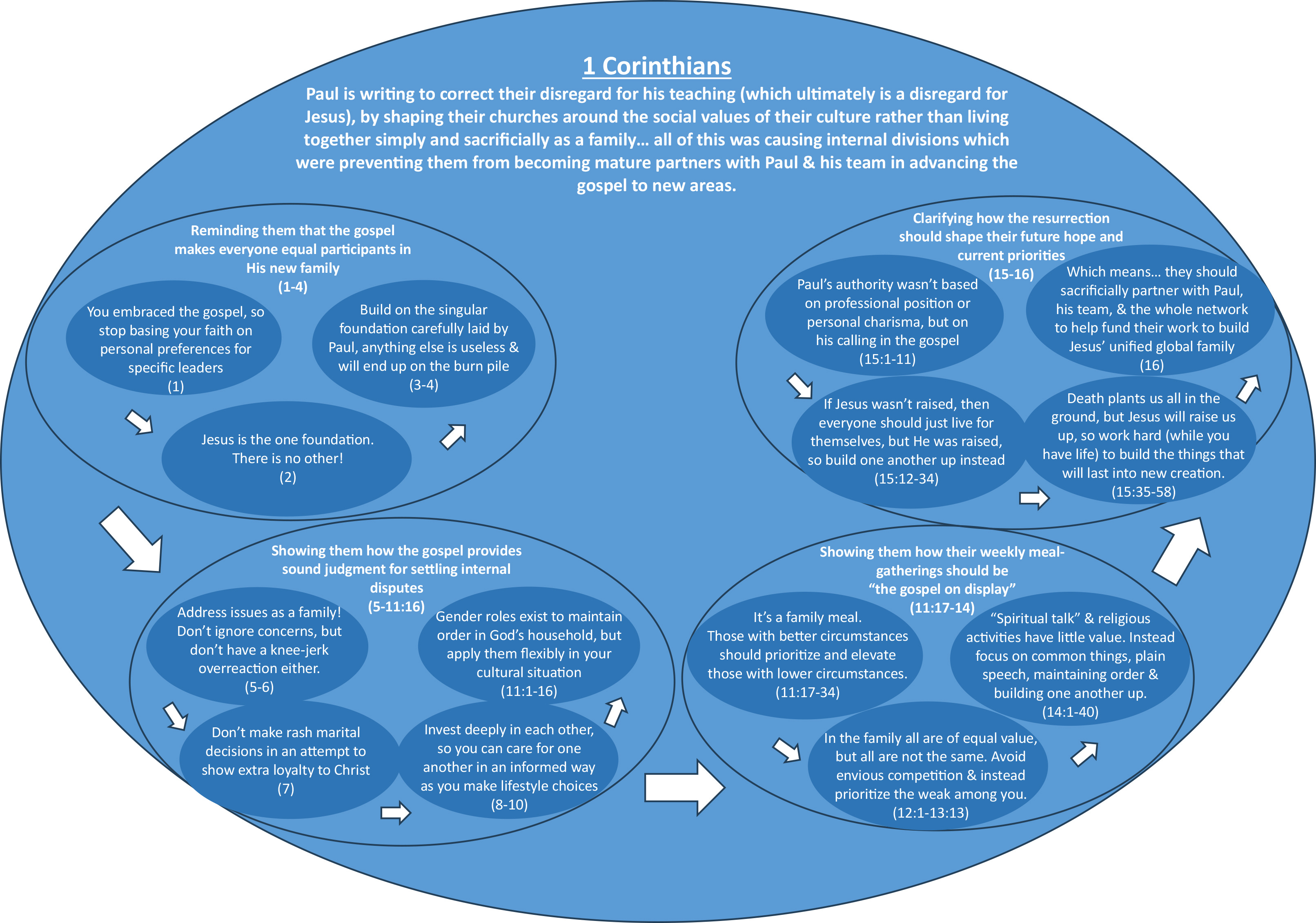
Here is my one page summary of 1 Corinthians.
Scott Canion is based out of the NYC area and is part of the METRO equipping team, a network of global leaders who are establishing churches that are families, patterning themselves after Acts.
This is a good handling of the passages in light of the household structure of the church. We coukd discuss what is culturally appropriate for discussion in the simple church meetings. It could also mean that if someone has a disagreement with the teaching of the leader, whether male or female, this could be dealt with privately, outside the meeting. Then any clarification if needed could be offered by the leader to the group publicly. I think we are doing this.