


Paul took a “no theology” approach to training his leaders and establishing churches. What do I mean by a “no theology” approach?
Paul took an integrated, dynamic approach to theology. He had an apostolic traditioning process that he relied on himself and that was part of the authoritative tradition he passed on to his key leaders, instructing them to continue using it in every generation.
Paul shaped his theology in the situation, rather than creating a static, logic-based system that situations had to try and fit themselves around. He understood Christ’s plan and primary tradition, and was able to strategize and skillfully address problems as they arose, creating the ability to recognize cracks early on and address them quickly. He intentionally passed on this traditioning model to his team of leaders, commissioning them to pass it on to apostolic leaders in every generation, so that Christ’s global family would always be equipped to address situations they encountered in any culture and in every generation.
Luke Timothy Johnson, who originated this idea of no “theology of Paul” says the following:
“In short, philosophy, rather than being envisaged as a shared quest for wisdom, became a recital of biographically based systems of thought.”
“Students are vaguely aware that this “Platonism” is based on and supposedtly stated in a set of literary works called Plato’s Dialogues. But their knowledge of what they call Platonism turns out not to be based on a reading of those dialogues; it is based on the summary found in their textbook.”
“In the same way we continue to teach Hume and Kant and Hegel and Marx in succession and in terms of their “philosophical ideas” within set categories of cosmology, epistemology, metwphysics, and ethics. The carryover to the teaching of theology is direct and clear. Seminarians study the theology of Thomas Aquinas, Luther, Calvin, Barth, and Tillich as discrete thinkers, with an emphasis on how their “systematic theologies” converge and differ, rather than simply learning to think theologically while engaging these and other authors in all their specificity.”
“The same impulse, I suggest, drives the quest for a theology of Paul: it is abstract and provides an easily grasped handle on the apostle.”
“Of what possible use are such constructions, except to replace the actual reading of Paul’s letters? Yet, even as they purportedly make Paul “make sense,” they simultaneously block access to his astonishingly rich and difficult discourse as it is found in his actual letters.”
Luke Timothy Johnson, from The Canonical Paul, Volume 2, Interpreting Paul
N. T. Wright comments on the same “no theology” concept using the term “rationalist apologetics” to make a critique simila to that of Johnson. Wright prefers to talk about it in terms of the new post-resurrection gospel system, emphasizing that one cannot relate to the new system in terms of the rules of the old system.
“What I’m here calling Christian theology, in inverted commas, is the activity of the whole church, thinking with renewed minds and hearts, thinking scripturally, prayerfully, commonly about who the one God is, who God’s people are, and what God’s future is for the world.
Part of my point is that he [Paul] knows it’s no good just giving people rules. The rules make little or no sense within the old world. Just as the resurrection of Jesus makes no sense in the old world. So many debates about the resurrection of Jesus, in your country particularly [USA], where people try to do rationalist apologetics, or rationalist counter apologetics, is as though you are trying to fit the resurrection into the old world, it can’t be done. The resurrection is the beginning of the new world. The shock of that is that it’s not a different world, it’s the transformation of the old world from within.”
NT Wright, from Why and How Paul Invented Christian Theology
This means we have to understand Christ’s plan and principles very well (and understand Paul’s traditioning process) and be able to hold all of that in our heads simultaneously, so that we can address specific situations in our ministry contexts from that singular tradition (TWCA) in a way that is flexible and situational for each time and context.
We also have to train everyone in our churches to be able to think in a principled, integrated way across the concepts and principles of Jesus’ plan (Wright’s “think Christianly” idea), so that the churches can be turned loose to continue maturing and expanding. This means helping them understand that theology is not a static set of statements that we all agree should never be adjusted, but that theology is the outworking of the patterns and processes from Acts and the apostolic writings (built around Paul’s framework) brought into various church situations that will continue to change and adjust over time, and that as these concepts are better understood and situations change, the specifics of how the patterns and principles of Christ’s plan are administered will change as well.
“Paul is teaching the church to think Christianly. And not only so but to think about thinking Christianly. To reflect on what it is that they are now being required to do. To think their way around the fact that there is a new form of wisdom to be dispensed among the mature. And then a few chapters later Paul has a sustained piece of theological or meta-theological teaching.”
NT Wright from Why and How Paul Invented Christian Theology
Jeff Reed adds to this conversation across much of his writing, but here is a short quote specifically about how Paul was engaging in his traditioning process with the Corinthian churches.
“Paul delivered the traditions he received from Christ with confidence and authority, yet with a clear understanding that the Corinthians needed to learn how to think at a principle level, producing the cultural flexibility needed to preserve their unity at a practical cultural level.”
Jeff Reed, from The Corinthian Letters: Progressing the Gospel Through Multiplying Churches
Reed refers to this same concept as “apostolic traditioning” which is to be passed on from generation to generation so that in every generation and in any culture problems can be solved flexibly using the gospel.
The unique contribution that Reed adds to this conversation is the concept of apostolic leaders, apostolic teams and apostolic authority, which are critical to the establishment of church networks and are absolutely essential for effectively carrying out the apostolic traditioning process and ensuring that it remains in place from generation to generation.
Below is my simple contrast of how Western Christianity tends to approach systematic theology, versus Paul’s “no theology” apostolic traditioning approach.
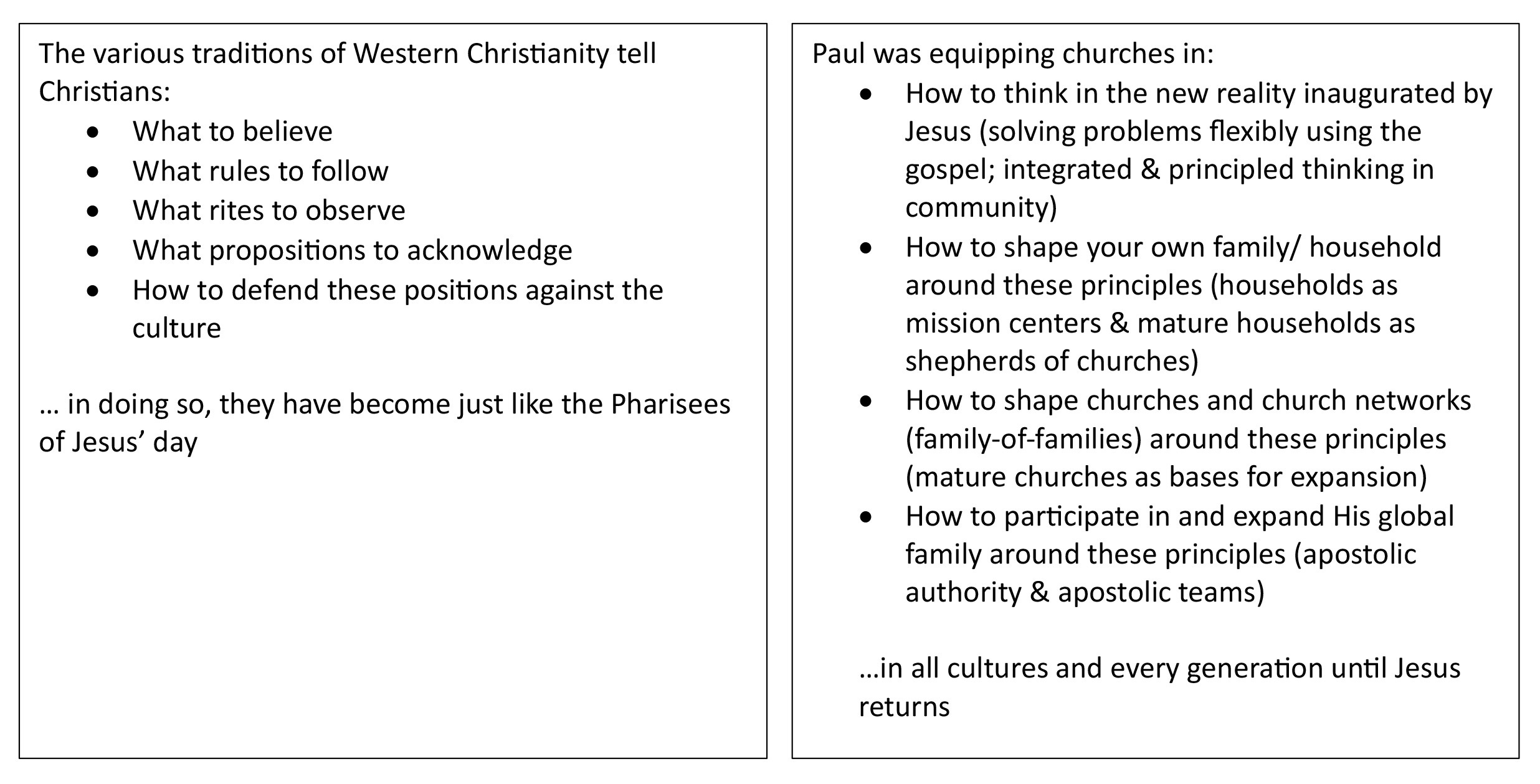
All of this together makes a strong argument for the need to recover Paul’s method for doing theology for the purpose of establishing churches, and should make us reconsider our commitments to systematic theologies and the various traditions they have created, which have been locked in centuries of wrangling over useless details. Instead, we need leaders and churches who are willing to think laterally, freeing themselves from the systems that have dominated much of Christianity for centuries.