

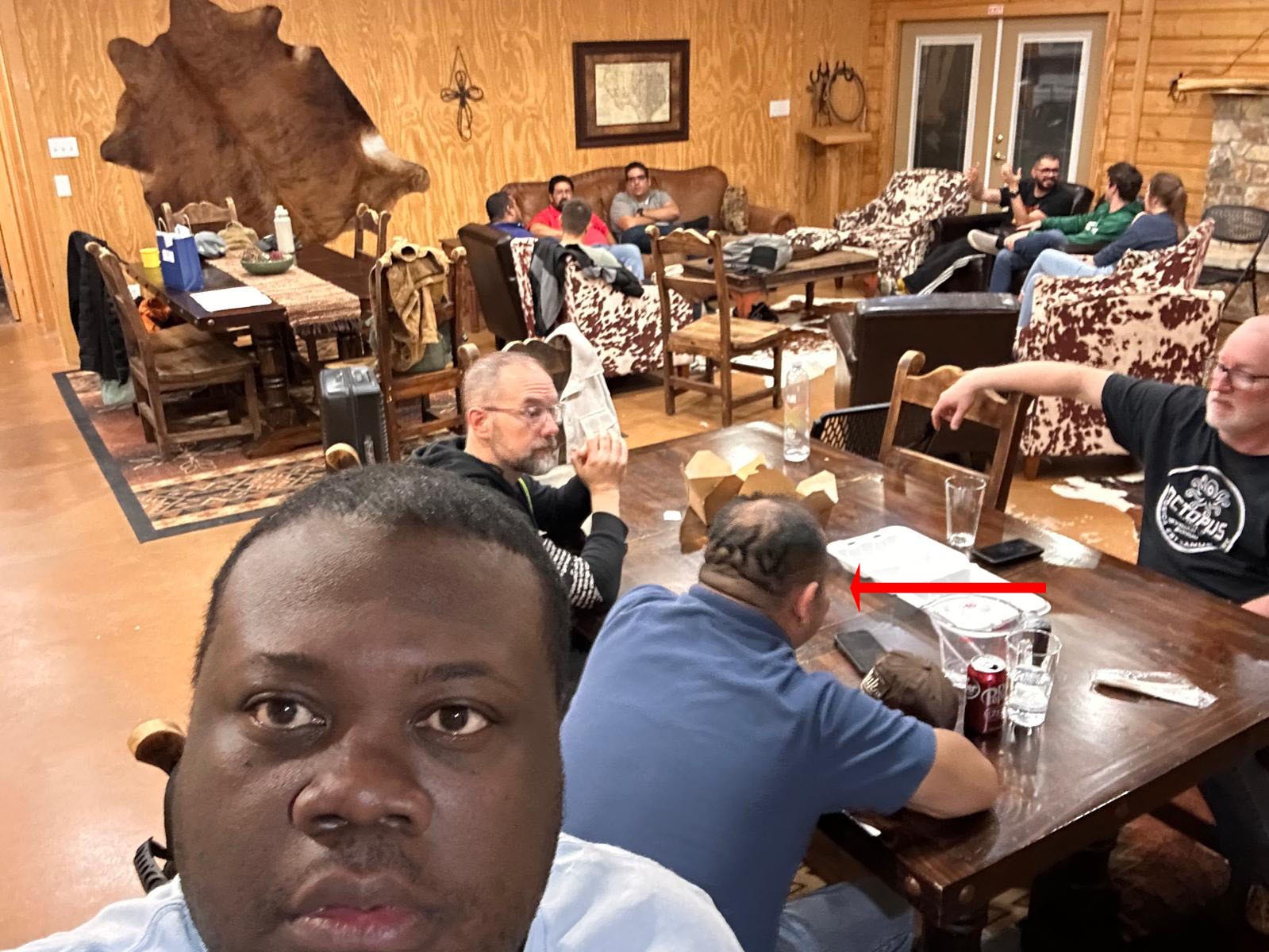
[Sorry Juan, the only pic I had of you was from this angle.]
The first night of the conference, everyone was still a bit dazed from our long journeys. We all sat around after dinner getting to know one another and not expecting much, given our current condition. Juan, a leader we had never met before, sat at the table with us and began describing his situation. He and his wife have been tasked by their supporting agency to go plant traditional churches in the St. Louis area, with the goal of forming worship services and acquiring space in a building. Juan seemed unsure and a little overwhelmed about how he was going to accomplish this. He talked to us about how he currently has two separate informal gatherings of people that get together intermittently throughout the month in non-religious spaces. (And by non-religious spaces I don’t mean that they meet in Bill Maher’s basement, I mean locations other than church buildings. Places like a garage or a community center.)
Juan shared with us that he felt like he wasn’t making much progress toward meeting these goals. All he had were two small groups of people gathering around food, fun, and conversation, and he felt discouraged about what he perceived as a lack of progress with establishing them as a local church. But when he heard us talking about how our churches meet each week to eat a meal together (bookended by the bread and the cup) and how that is essential for building true community that is rooted in the sort of gospel-shaped, selfless love Paul describes in 1 Corinthians 13, his spirits began to lift.
For years he and his wife have been working feverishly to build these relationships and now he felt pressure to move them from simple gatherings around food to more formal church services. This, he thought, was how you establish a church. (I mean, this is what most of us grew up thinking it meant to plant a new church, isn’t it?) He has been puzzled and discouraged for some time about how to accomplish this. Imagine his genuine joy upon discovering that he has already intuitively been engaging with these families in a way that is very similar to how the early churches gathered… as small, simple gatherings, clustered together in cities and networked across regions by apostolic-type leaders who shaped them and helped them become mature communities who then became bases for further expansion of the gospel into new areas. The pure joy of this realization was irrepressibly visible on his face and expressed in his uncontainable excitement. (When Juan gets really excited, he raises his eyebrows, which makes the back of his scalp resemble a Shar Pei. This is how I knew when he was connecting with something we were talking about.) We could see the stress melting away as he came to realize that he was already on the right track to build this “church as family” model.
We spent the next couple of hours asking questions about his situation and talking through how he could begin training leaders to help him, and how he could continue infusing those situations with the gospel to help bind them together in the truth of what Jesus accomplished and what it means for churches today.
Juan was a different person after this interaction, participating with fervor and vigor and asking questions so that he could return to St. Louis empowered to begin solving problems and making progress in his situation.