Questions to Identify the Key Issues:
What did Jesus tell these two disciples that opened their eyes to who He really was and what He was doing?
How did He accomplish all of that in just a brief conversation as they walked along the road?
How were Paul and the Apostles able to understand the implications of that story so well, that they confidently (with clear understanding) and authoritatively (on behalf of Jesus) shaped the tradition for all the churches around its implications? (The tradition which remained intact for the first 300 years of the church - 12 generations. And even after it began to fragment, the fragmented pieces of it continued influencing Western Civilization until only very recently.)
Why then, is it particularly important in our day and age to recover the story Jesus told them and the tradition that the Apostles shaped around its implications?
The Supporting Concepts:
Why is the Emmaus road narrative so important?
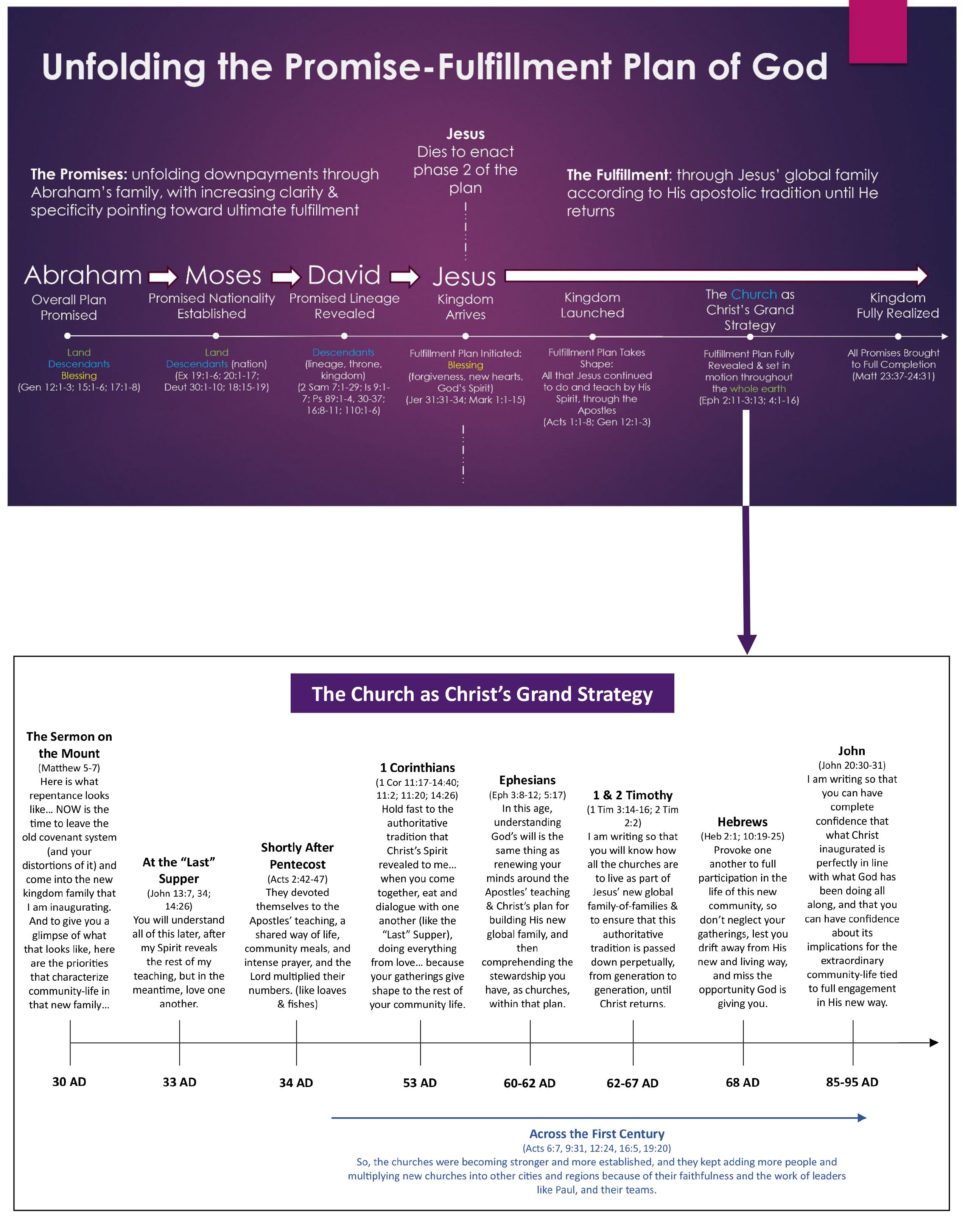
It is clear that Luke has included this story near the end of his first volume (Luke 24:13-35) so that we tie it together with the framework revealed by Jesus’ Spirit to His apostles, which is laid out in Luke’s second volume (Acts). The Emmaus road story makes the point that while those two followers of Jesus were sincere in their love for Him, their lack of understanding of the overall storyline of the Scriptures had blinded them to all that He had begun to do and teach, and if not understood properly, would prevent them from participating with Him in phase two of that plan… building His global family.
How can we know what Jesus said to the disciples on the Emmaus road?
Luke is intentionally making the connection for us that the storytelling done by the apostles in Acts (7:1-53; 13:13-41; & Peter’s five sermons 2:14-39; 3:11-4:4; 4:8-12; 5:29-32; 10:34-43) was the same storytelling done by Jesus with the two disciples on the road to Emmaus – the story of God’s promises to Abraham’s family and His making good on those promises through numerous “down payments” throughout history and ultimately through Jesus and the plan that His Spirit revealed to His apostles for building His global family.
Why start the story with Abraham instead of Adam?
The story that is told over and over by the apostles is the story of God’s promises to Abraham’s family and His making good on those promises. This is the biblical metanarrative (the overarching storyline of the Scriptures) which is encapsulated in the promises to Abraham in Genesis 12. Gen 1-11 is meant to prepare us for the start of this story. (e.g. The whole point of the Noah narrative is that some other type of plan is needed. A plan where hearts are made new within the context of a new family. Simply eliminating evil people and starting over doesn’t solve the problem. You still end up with Babel. Cue the promises to Abram and His family…)
How important is it for us to recover this story today?
Jesus was clear with His disciples that He was only giving them a glimpse of what was coming. He tells them that after He leaves, His Spirit will reveal everything else and that one day they will reflect on everything He had said to them and finally understand it (Jn 12:16; 13:1-7; 14:26). Doesn’t it make sense that if we want to understand what Jesus said, we need to follow the same process the apostles followed? Understand that same story. Devote ourselves to the Apostles’ subsequent teaching. And then shape our lives and churches around it. What happens if we fail to follow this process, or if we replace it with some other process? What happens if we simply cling to the leftover fragments of this tradition, without recovering it fully?