We are living in the middle of a macro-paradigm change in Western civilization (which basically means the entire world, since Western civilization has influenced nearly every place on earth over the past 500 years.) In 1991, David Bosch, the insightful missiologist, wrote in his seminal, prophetic book, Transforming Mission:
“There is growing awareness that we live in an era of change from one way of understanding reality to another… macro-paradigms go through a period of fundamental change every three to five-hundred years. It is abundantly clear that the twentieth-century… shows evidence of such a major shift in perceiving reality. Since the seventeenth-century the Enlightenment paradigm has reigned supreme in all disciplines, including theology. Today there is a growing sense of dissatisfaction with the enlightenment and a quest for a new approach to understanding reality. There is, on the one hand, a search under way for a new paradigm; on the other hand, such a new paradigm is already presenting itself.”
Below is my take on how multiple macro-paradigm shifts over the past seventeen-hundred years have shaped Jesus’ church (not always positively), and what we must do today to ensure that the next paradigm of the church aligns with the patterns and principles of Jesus’ teachings (a.k.a. the apostles’ teaching, the deposit, sound doctrine, the didache, etc.)
In its first 250 years the church thrived and rapidly expanded as communities that lived sincerely together as extended families (Acts 2:42-47) and were supported and strengthened by apostolic teams who shaped them as hubs, clusters, and nodes for the express purpose of accelerating spontaneous expansion among and beyond those church networks.
By the 4th Century, in an effort to influence the legal and philosophical systems of the surrounding culture, Christianity began to slowly merge with these systems obscuring the apostolic tradition, and eventually replacing it with a cultural hybrid (Christendom) that remained dominant for 1,700 years.
In the 19th and 20th centuries, there has been a growing recognition of the ineffectiveness of Christendom institutions and paradigms to fulfill Jesus’ mission of producing transformed communities (coinciding with the waning influence of Enlightenment ideas).
Christendom has now run its course and no longer provides the “singular narrative and imaginative vision”1 for the institutional church or Western Civilization
The church has now entered a New Apostolic Age much like the first few centuries of its existence
The challenge laid before our generation is to avoid simply “remaining zealous for the traditions of our fathers”2 and instead to vigorously “contend for the faith which was once for all delivered to the saints”,3 by recovering the patterns, principles, and processes from Acts and Paul’s letters (around which the entire New Testament is structured)
Although the 20th Century has seen a strong return to large scale church planting models, including both house church and cell church models, the approach to these is largely still based on institutional models, missing the key patterns, processes and principles of Christ’s plan.
Because of the stewardship Jesus’ gave to Paul, we understand that Jesus’ expectation was that His churches would follow these patterns perpetually
Jesus’ focus during His time on earth was busting up the existing Jewish traditions through veiled teaching and insinuating He was Messiah, then intentionally disorienting His followers around their old paradigm, all as He marched toward His death and resurrection.
Jesus tells His followers that His Spirit will teach them everything else after He is gone (John 14:26) giving them the keys for how to carry out His kingdom-building work (Matt 16:18)
Acts contains the framework and patterns for everything else – “all that Jesus continued to do and teach” by His Spirit, through the Apostles, in His church (Acts 1:1-4)
Acts also emphasizes the role of Paul, by highlighting how Jesus makes an “encore appearance”, specifically to commission Paul and give him a unique stewardship (Acts 9:1-16)
Later, in one of his middle letters, Paul clarifies the content of that stewardship, which was to reveal and implement Christ’s Grand Strategy for the churches (“the plan of the mystery”) throughout the Gentile world, thereby building Jesus’ one unified global family (Eph 3:7-12)
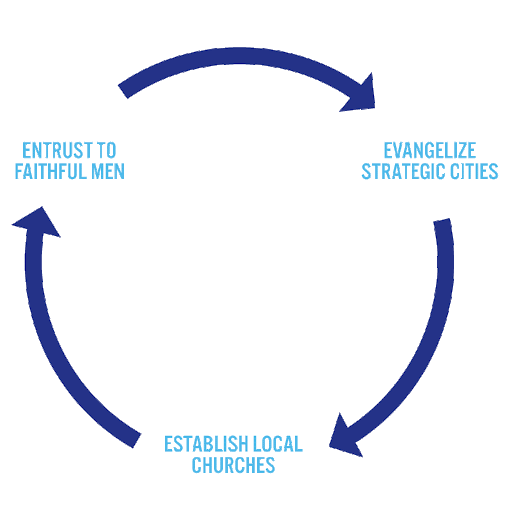
Paul understood his stewardship in terms of expanding his own sphere and multiplying local churches across an Empire-wide movement by constantly engaging in a cycle of4:
Evangelizing strategic cities
Establishing local churches
Entrusting them to faithful men
Paul was a coherent thinker whose circular letters were shaped around central organizing statements (topos) whose implications he would apply situationally to the recipients, while expecting the other churches in his field to engage with those letters and do the same theology-in-culture process, applying the gospel flexibly in their situations
Paul understood the function of his apostolic role to be critical for the ongoing stability and spontaneous expansion of church networks, and engaged in training other young, gifted leaders to continue those functions, instructing them to train others in the next generation who would train those after them. (2 Tim 2:2; John 17:20-23)
The conclusion being… there is only one Lord, one faith, one baptism and one “way”… to participate in the expansion of His global family according to the plan revealed to Paul (Eph 4:1-16)
From Christendom to Apostolic Mission, James Shea, University of Mary Press, 2020
Galatians 1:11-14
Jude 1:3