

[Note: This essay is written as a sort of FAQ to address the key questions regarding Matthew’s gospel and the Sermon on the Mount.]
Question #1
Isn’t Matthew’s gospel (and the other gospels for that matter) a collection of the life and teachings of Jesus? Shouldn’t we pattern our lives around Jesus’ example and teaching? Consequently, shouldn’t we use the gospels as the model for Christian life and practice?
Let’s look at the context of what Jesus was doing when He was here, and how Matthew perceived Jesus’ teaching after 30 years of participation in, and theological reflection on, all that Jesus’ Spirit accomplished in the churches through the Apostles. (Matthew was written around 65AD.)
What Was the Primary Focus of Jesus’ Ministry?
Upending Jewish traditions, challenging Jewish authorities, insinuating His Messiahship
Carefully veiling His teaching (which would later be plainly taught by the Apostles – Jn. 14:25-26)
Disorienting His followers, detaching them from their old paradigm
Marching toward His death & resurrection
What is the Primary Focus of the Gospels?
Stabilizing existing church networks near the end of the first century as the apostles were preparing to leave the scene:
Jewish Churches… exhorting them to hold fast. (Do not give in and return to prior traditions!!)
Gentile Churches… helping them fully grasp their vast Old Testament heritage through apostolic eyes
What is the Primary Focus of Matthew’s Gospel?
Stabilizing Peter’s ethnic diaspora network (Jewish diaspora churches) by showing clear continuity between the OT and Jesus’ global family movement through five discourses that call Israel to repent, leave their religious traditions behind, and follow Messiah into His kingdom, while predicting their rejection1
The narrow path into the kingdom (contains Sermon on the Mount)
Spreading the message throughout Israel
Future growth of the kingdom among the Gentiles
Prediction of the rejection of Messiah and death on the cross
The coming judgment on Israel is predicted
What is the Primary Focus of the Sermon on the Mount?
A call for the churches to forsake old, rules-based religious traditions and recognize that Jesus has inaugurated His kingdom, as a new global family, who are to live together according to a new and better way
John the Baptist’s call to Israel to “repent for the kingdom of God is here…”
The five discourses of Matthew’s gospel are messages arguing for Israel’s repentance from ignoring the trajectory and true meaning of the OT traditions and tabernacle system
The Sermon on the Mount is showing Israel what it looks like to repent from the Old Testament paradigm2 and become part of the new family Jesus is building (highlighting the priorities that characterize community-life in Jesus’ family)
Conclusions for this section were drawn heavily from Matthew: I Will Build My Church by Jeff Reed
Conclusion #1
The gospels, and particularly the acts and teachings of Jesus contained in them, were never intended by Jesus to be the biblical model for Christian life and discipleship, or for mission strategy. Jesus intentionally left those teachings and that strategy to be delivered by the Apostles and He promised that after the Apostles delivered the rest of His teaching, His disciples would one day look back and fully understand the veiled teaching He brought while on earth (Jn 14:26.) This is precisely what Matthew is doing in his gospel.
The organizing center of the New Testament and the framework for Christ’s plan are found in Acts and Paul’s letters. This is emphasized by Jesus making an “encore appearance” to specifically choose Paul (Acts 9) for the unique role of taking the gospel to the Gentiles (Jesus’ global family) and revealing and implementing Christ’s strategy (His model for all the churches), ensuring it was followed in all the churches (1 Cor 11:163) and that it was understood and adhered to by the other apostles (Gal. 2:11-13.) The other apostles recognized Paul’s role and aligned their work with this plan, as seen in their writings, which reinforce this shared vision across church networks. (2 Pet. 3:16)4
“The sermon [on the mount] – to take it for the moment as a whole – is not a mere miscellany of ethical instruction. It cannot be generalized into a set of suggestions, or even commands, on how to be ‘good.’ Nor can it be turned into a guide map for how to go to ‘heaven’ after death. It is rather, as it stands, a challenge for Israel to be Israel.” – N. T. Wright
… or more accurately, a challenge for how Israel should repent and follow Jesus into His new community.
Question #2
If Matthew is writing his gospel with ”the way of Christ and His Apostles” paradigm in mind, shouldn’t we see some evidence of that in his gospel, or in the other letters written to the scattered Jewish believers and their churches?
Where is the evidence for “the way of Christ and His Apostles”?
Matthew describes how Jesus was introducing and laying the foundation for His new global family.
While the rest of the New Testament flows forward from the narrative of Matthew, the entire New Testament is actually organized around the concepts in Acts & Paul’s letters. If those are not understsood first, it is nearly impossible to grasp what Matthew is doing.
“Repent from your distorted Judaism and become part of Jesus’ new global family” – Matt 3:2; 4:17
“I will build my gatherings” – Matt 16:18
“Go build my gatherings” – Matt 28:18-20
How to build His gatherings as interconnected gatherings (complex networks) who live as gospel-shaped (kerygmatic) communities – Acts (overall framework)
How to plant, root, build up and stabilize these gatherings (families of families) in any situation, culture, region or time of history – Paul’s early letters
How to engage these churches in fulfilling their calling within Christ’s grand strategy – Paul's middle letters
How to recognize, train and maintain solid leadership across Jesus’ household (apostolic-types, elders, leading women, one-anothering) – Paul’s later letters
How to address issues/conflicts across networks of ethnic churches – Petrine circle of writings
How to shape and stabilize small regional networks of gatherings and created one-minded solidarity across Jesus’ global family movement – John’s writings
How to live the abundant life amid difficulty, conflict and the coming “end of the age” – Revelation
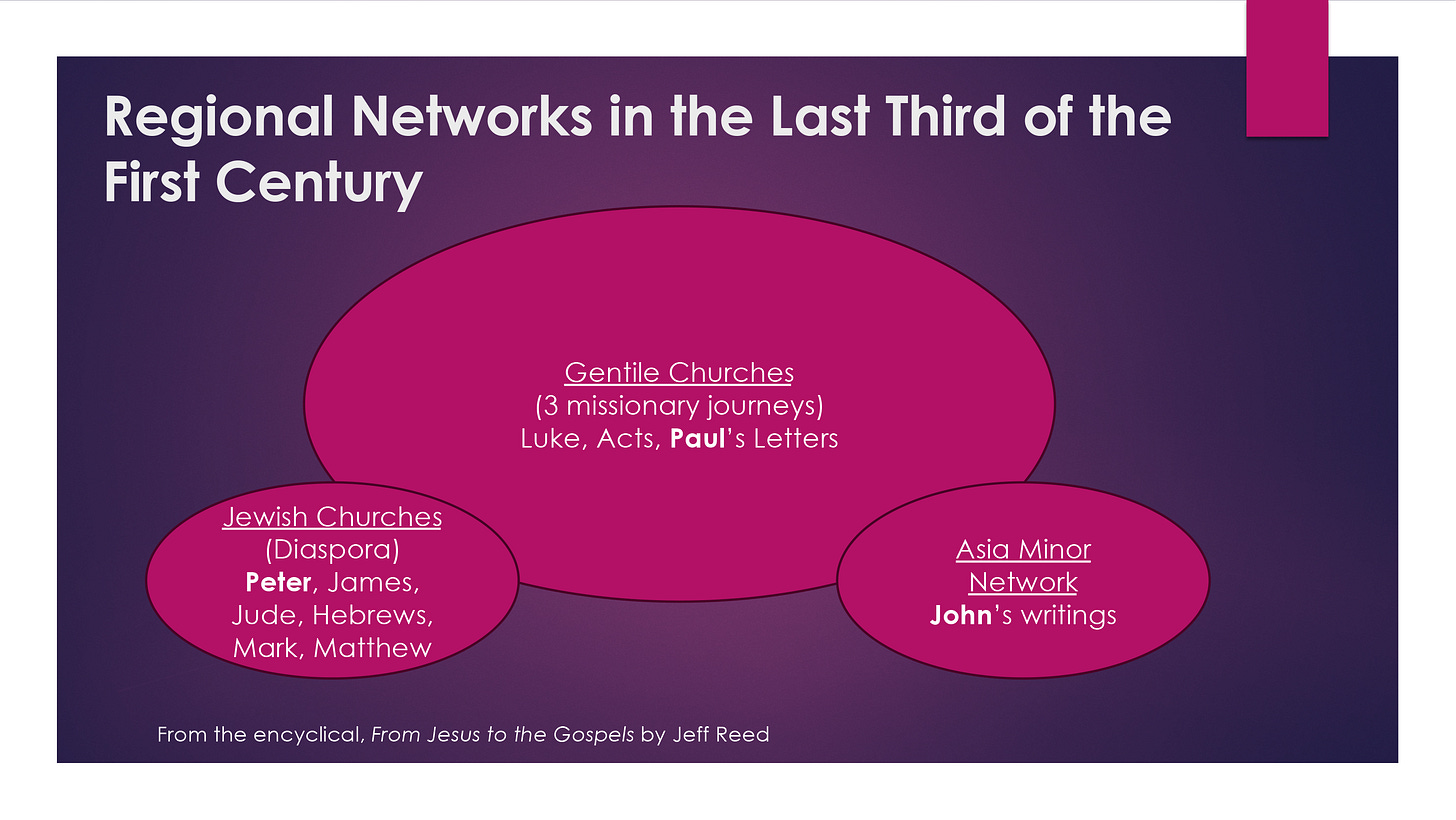
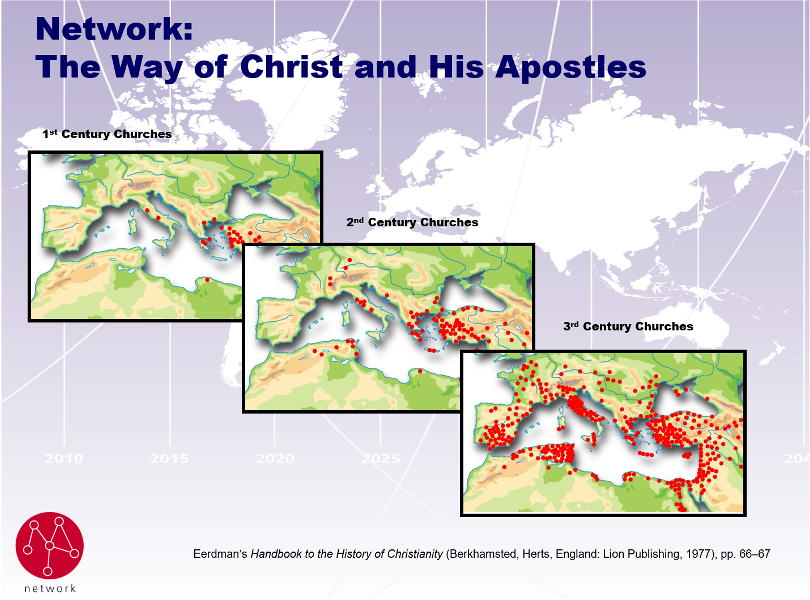
All the churches were established around “the way of Christ and His Apostles” paradigm5 and they continued expanding6 for the next 200 years due to their faithfulness. So, when the late first-century churches read Matthew 5-7 they weren’t simply hearing Jesus’ talking to a crowd sitting on a hill, they were hearing His voice filtered through decades of their own participation in all that He continued to accomplish by His Spirit through the apostles in the churches. Finally they were able to clearly understand what Jesus meant when he delivered that veiled teaching all those years ago.
Matthew is referring to “the way of Christ and His Apostles” when he uses the way of righteousness in the passage we refer to as the Beatitudes.7 Why do I bring this up? Because righteousness is a paradigm term that Matthew is using to connect the dots for the scattered Jewish believers near the end of the first century. When he uses the term righteousness, he is not referring to personal morality or the status Christians have in Christ. Instead, he is referring to Jesus’ “kingdom justice system”, through which He brings order and justice to the world. The Greek word for righteousness, dikaiosyne (di-kah-i-oh-sooh-nay), has a range of meaning that includes justice, judgment, vindication, and punishment. The idea is this… living in Jesus’ New Covenant means embracing His new justice system—a.k.a. His global family paradigm, as understood from Acts and Paul’s letters. This new family, living according to His new way, is His framework for restoring order to the world and shaping the New Creation.
Are there other writings to these scattered Jewish believers that can help make things clearer?
The book of Hebrews also clarifies this concept, as it predates Matthew’s gospel and exhorts the scattered Jewish believers to hold fast to Jesus’ “new and living way”, clarifying that it does not abolish the Old Testament Law but completes it, bringing it to an end (Matt 5:17), and then taking it further up and further into God’s plan. The Law was not a failed plan—it was always meant to be Phase One of God’s eternal purpose, like booster rockets on a space shuttle. Once their job is done, they fall away. Not because they failed, but because they completed the fulfilled their purpose, successfully launching God’s plan into its next stage.8
In Hebrews 8:1-7, the author describes Jesus’ New Covenant using Greek words whose meanings range across the concepts of pattern, prototype, and model. One of these words, hypodiegma, (deigma being the root for the word 'paradigm'), reinforces the idea that the old tabernacle system was just a shadow of what was to come. But now, believers have received Jesus’ new paradigm with a new set of patterns to follow (the didache.)
The Jewish believers were under immense pressure from all sides and were not well-grounded in the first principles (Heb 5:12). The writer of Hebrews urges them to hold fast to their commitments to their new church families and master these foundational principles, even when it feels like everything is against them. If they do not remain firm, they risk rejecting Jesus’ “new and living way” and returning to outdated, outmoded traditions. And if they turn back, they will likely end up “wandering the wilderness” for the rest of their lives, missing out on God’s plan and facing judgment along with the rest of Israel—just like their ancestors.
All the New Testament authors shared a common plan and strategy but adapted their descriptions of it to different ethnic and geographic contexts. They shaped their ministries around it, writing letters and documents to strengthen churches within Jesus’ new paradigm. While they used similar terms to describe this new way, their words were later translated into English in ways that obscured their connections. Over time, the meanings of those English words evolved even further, making them seem completely unrelated. To grasp their original relationships, we must examine the original Greek words.
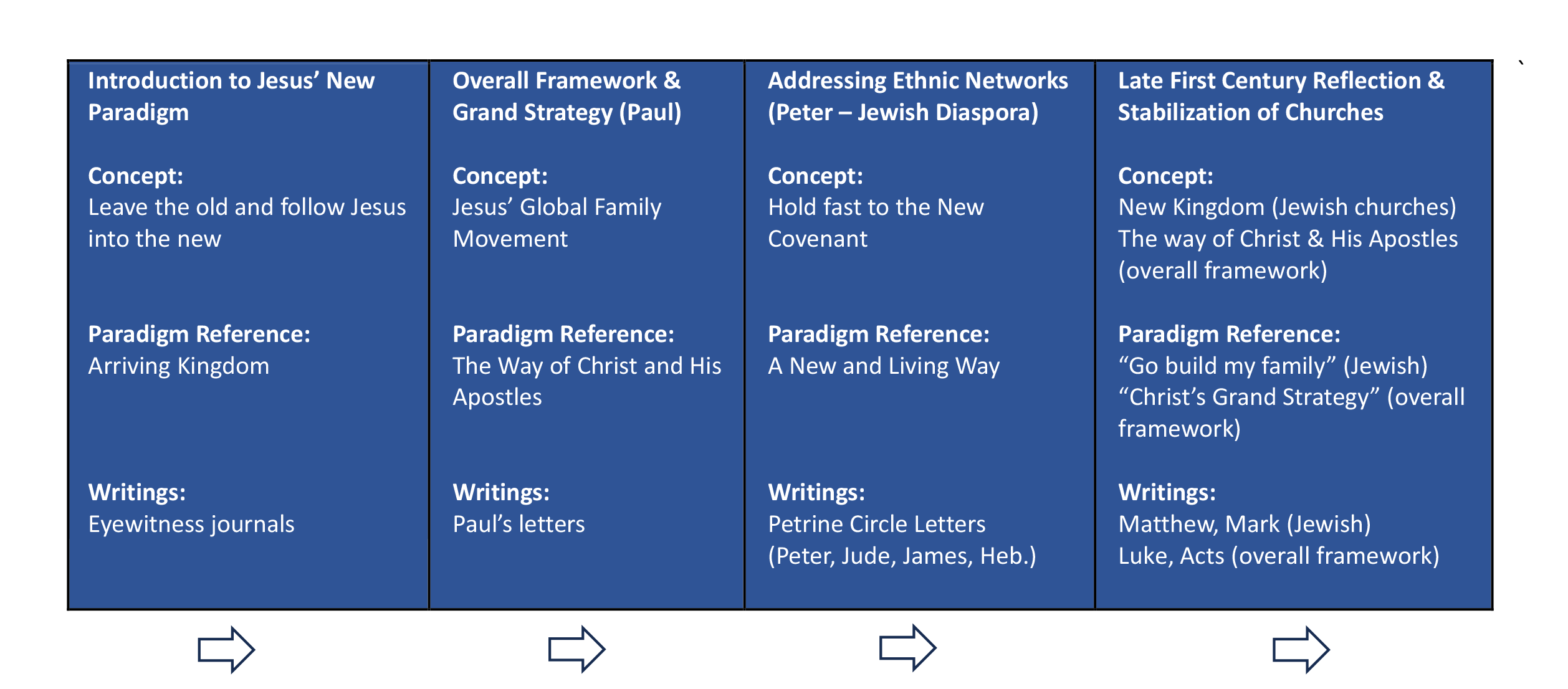
(The following chart is meant to provide a very basic description of how the paradigm ideas are referred to and developed across the first century.)
Conclusion #2
So, if Jesus was guardedly introducing a new paradigm, and Matthew structured his gospel around its announcement—emphasizing John the Baptist’s call for Israel to repent from their corrupted version of the rules & rituals based tabernacle system (old paradigm) and turn to Jesus’ principle-based global family movement (new paradigm)—then this call remains relevant for churches today insofar as our contemporary Christian traditions have wandered from that paradigm, either mixing in cultural practices, or even abandoning it altogether.
The Roll-Out of Jesus’ New Paradigm Across the First Century:
“It is a totally different thing then, when you view the letters in the New Testament as abstract documents that are used to support existing systematic theological constructs versus understanding them as tools for establishing churches.” – Jeff Reed
… in other words, much of Christianity looks at the New Testament letters and sees scattered bits of irrelevant information and therefore assumes that our task is to organize those bits into logical systems of topical categories that make sense by today’s standards, rather than seeing Paul’s unified, coherent strategy and arguments, which drove his work and organized his approach with the churches (centered on the stewardship he was given by Jesus).
Since the time of Constantine in the 4th Century, the trajectory of the Spirit’s work has been leading his church across numerous reformations to rediscover and follow Jesus’ new paradigm — what Roland Allen refers to as “the way of Christ and His Apostles”. Hebrews urges us to remain committed to this “new and living way” rather than retreating to familiar institutional systems that reduce faith to attending church, being moral, doing good deeds, and acknowledging God. Jesus’ plan cannot be reduced to such a checklist9 —since it is about building a global family movement. Jesus calls us to draw strength from one another, shaping our lives around His paradigm so we can withstand life’s pressures, face opposition, and respond wisely to those who do not understand our commitment. His plan is for us to process this journey together, engaging in ongoing dialogue, refining our understanding, and developing new expressions of faith in our church communities. As we do this, we will strengthen one another, mature in our faith, and become unshakable in His “new and living way.”
Is there an example where we can see this clearly in Matthew’s gospel? In the Sermon on the Mount?
I have paraphrased a few verses from this passage to help us hear it the same way Matthew’s audience would’ve heard it, after having lived out the Apostolic teaching for several decades within the context of their churches and networks. First, I will include the ESV version, then my paraphrase.
Matthew 5:46-48 ESV
“46 For if you love those who love you, what reward do you have? Do not even the tax collectors do the same? 47 And if you greet only your brothers, what more are you doing than others? Do not even the Gentiles do the same? 48 You therefore must be perfect, as your heavenly Father is perfect.” 10
Matthew 5:46-48 – Paraphrase incorporating late first century apostolic context
“If you approach your new way of life by just dutifully meeting minimum requirements, such as maintaining arms-length relationships that don’t require much of you, does that really build God’s kingdom (His new family)? Can that sort of behavior actually produce the outcome of true maturity (unshakable church families who contend for the faith)? Aren’t you just being average citizens? Many of the pagan people around you already know how to be good citizens. But your life together is supposed to be much more than that. You are supposed to make any necessary sacrifice to become strong, mature communities, so that you flourish as God’s family right here, right now… even in the midst of difficult circumstances.” – Matt 5:46-48
Matthew’s “narrow path into the kingdom” idea is not a reference for our 21st century situation about Christians who won’t make it into heaven. He is talking about first century Jewish people most of whom will reject Jesus’ (and John the Baptist’s) message to repent and therefore, will not become part of Jesus’ global family. They will remain in the wilderness until they die. They simply could not grasp or would not accept that there was a Phase 2 to God’s plan.
Conclusion #3
In other words, when we interact with Matthew’s gospel today, we need to hear the same message he was giving to his original audience, which was, give up on the old rules-based traditions, and the various ways they had distorted God’s plan, and turn and become a part of Jesus’ new family paradigm, completely reshaping their lives around it. Today, churches must take stock of all the ways that we have, in effect, gone back to the old “rules & rituals” paradigm as the structure for shaping our lives and practice. Then we need to turn and follow Christ’s plan.
Time to Change the System
“In aligning itself to the religious patterns of the day, the historic Orthodox Church, after Constantine in the 4th century AD, adopted a religious system which was in essence Old Testament, complete with priests, altar, a Christian temple (cathedral), frankincense and a Jewish, synagogue-style worship pattern. The Roman Catholic Church went on to canonize the system. Luther did reform the content of the gospel, but left the outer forms of "church" remarkably untouched; the Free-Churches freed the system from the State, the Baptists then baptized it, the Quakers dry-cleaned it, the Salvation Army put it into a uniform, the Pentecostals anointed it and the Charismatics renewed it, but until today nobody has really changed the superstructure. It is about time to do just that.” – Wolfgang Simson
… in other words, beginning in the 4th century AD the church began moving away from Jesus’ new paradigm (which the apostles gave their lives to shape the churches around), and instead incorporated itself around elements of the old paradigm.
Even with all the reform that has taken place through the centuries, much of what still constitutes the church’s life, practice, and gathering has remained largely untouched.
The Spirit has now brought us to the point in history where He is addressing this by awakening the church to a.) the failure of our institutions to maintain or produce mature churches and households, b.) the waning of Christendom’s influence on Western civilzation, and c.) our unsuccessful attempts to pass on a substantial faith to subsequent generations.
Now is the time to return to “the way of Christ and His Apostles.”
Scott Canion is based out of the NYC area and is part of the METRO equipping team, a coalition of leaders who are establishing churches that are families, patterning themselves after Acts.
See my summary of God’s unfolding Story
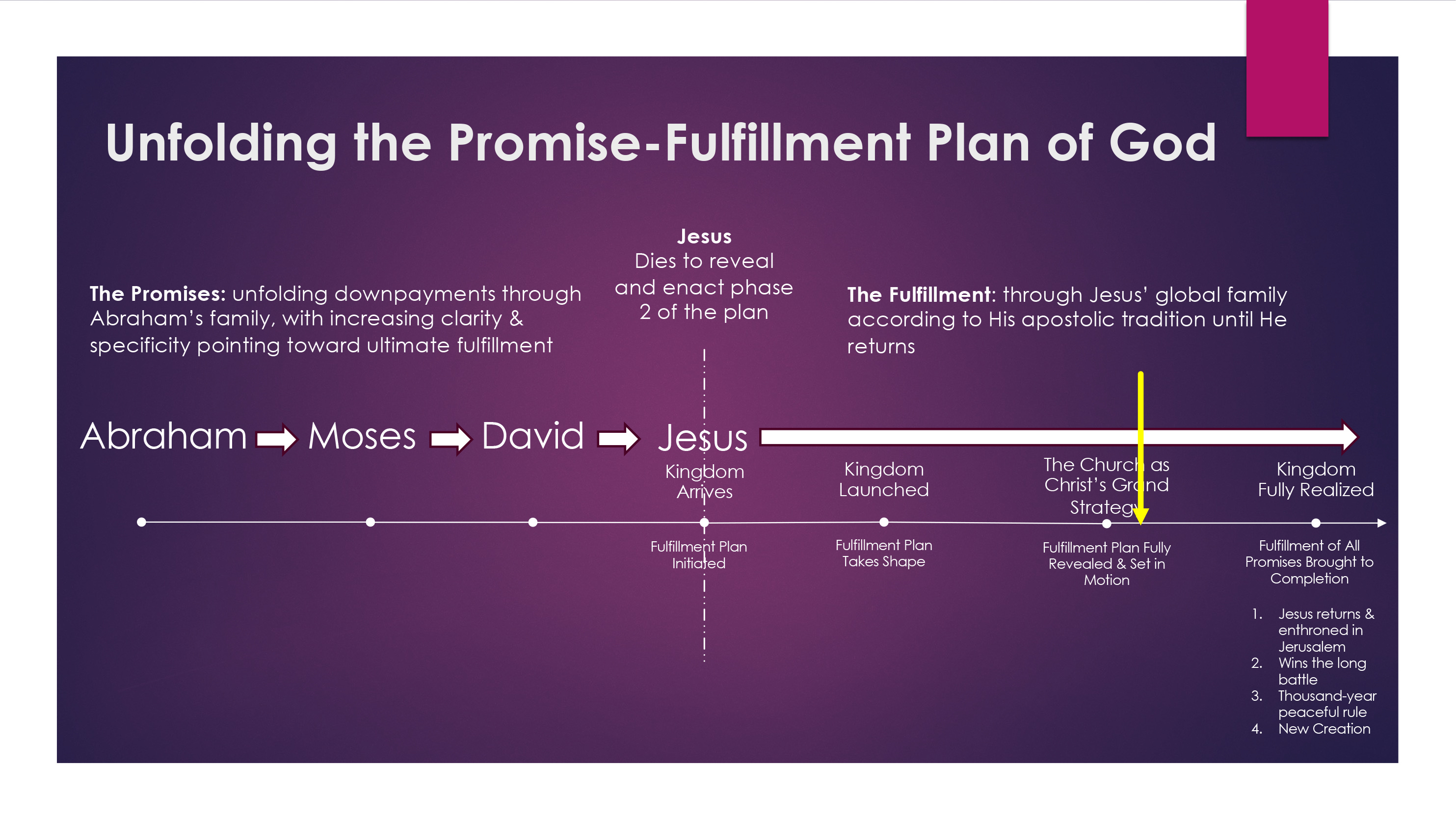
Paradigm: a set of beliefs, values & techniques shared by a given community – Thomas Kuhn
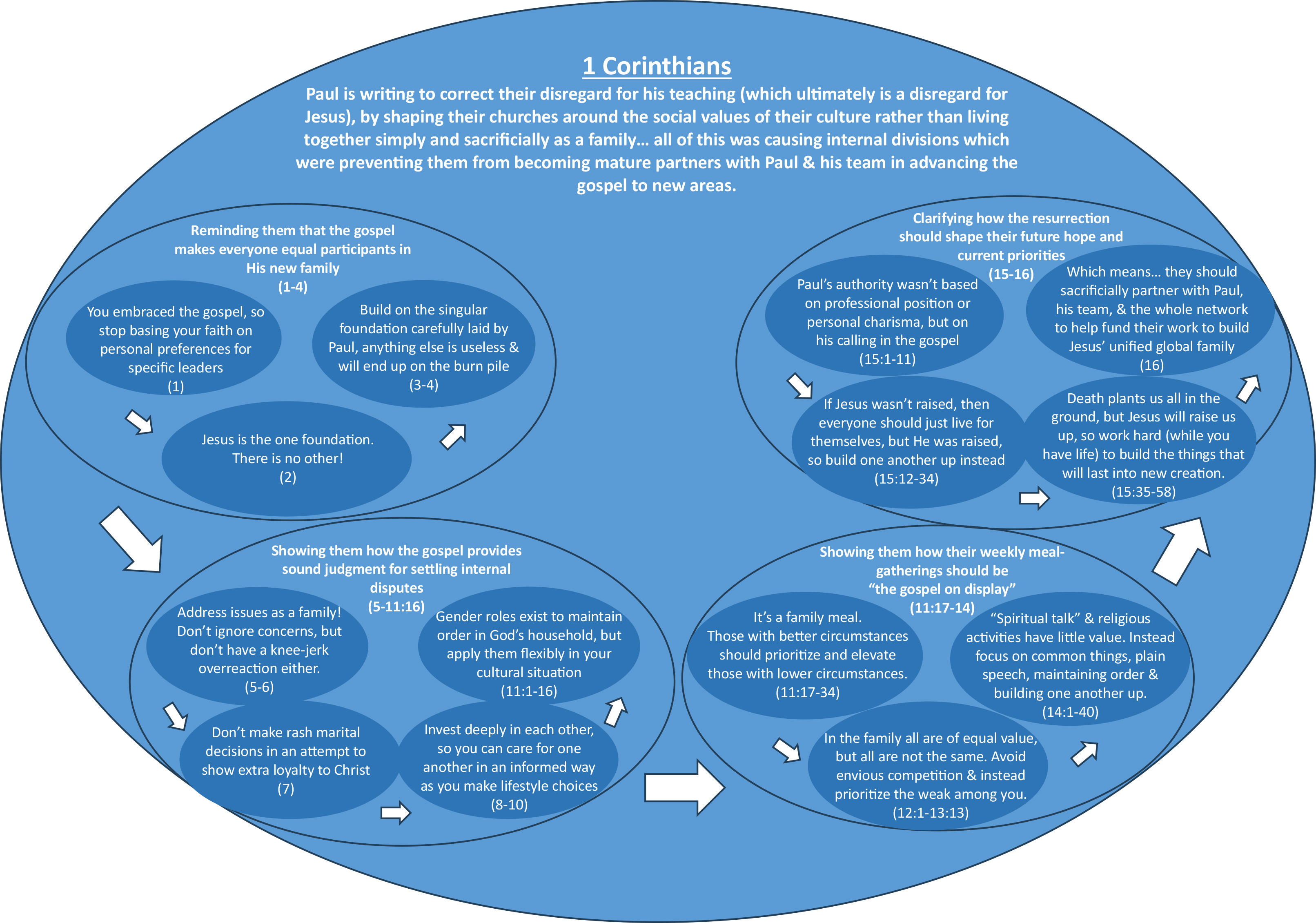
See my summary of 1 Corinthians
NOTE: We must become skilled at distinguishing between the actions of the characters in the historical narrative of the gospels (which happened around 30-33 AD), and the purpose of the documents which contain those stories and characters (which were written between 55-95 AD), and are being retold from an Apostolic perspective in the last third of the first century, after the empire-wide network of churches has been established and just before the Apostles begin dying and leaving the scene.
1 Corinthians 11:2-16; 2 Corinthians 11:22-28; Eph 1:15-23, 3:14-21; 1 Tim 6:20; Titus 1:9, 2:1; 2 Tim 4:2-4, 3:16-17; Acts 9:2, 18:26, 19:20-23, 22:4-21, 22:14-23,
The continued expansion of the church in the first three centuries.
“Righteousness… is actually a forensic term about God putting the world right” - Tom Wright
Rocket booster metaphor by N. T. Wright from interview with Tim Mackie
This checklist approach to Christian faith is like being a sports fanatic. You can watch the games, visit batting cages, wear the merch and even participate in a fantasy league, all without ever joining the team. The Western church has so romanticized its checklist versions of Christianity, that when presented with the real thing, many still prefer their familiar ‘fantasy league’ versions.
The Holy Bible: English Standard Version (Wheaton, IL: Crossway Bibles, 2016), Mt 5:46–48.