One-Anothering in the New Testament
What it means to embrace the gospel and be part of Jesus's family
Introduction:
Once again I am sharing an equipping tool that we are using in our church gatherings to create a conversation (and help set our life priorities around) how to be a church family, a kerygmatic community.1
Let me clarify a couple of things, which might help those reading this to better understand why I have organized it in this way.
First, we have to start thinking about the gospel differently.
For centuries, Christian traditions have buried the dramatic announcement of the gospel under a set of doctrinal statements. Those traditions approached the gospel the same way they approached the Scriptures . Namely, look at every place where a word/concept is mentioned, collect them into piles and then see which piles are the biggest. (An oversimplification, but you get the point.) This propositional version of the gospel mainly exists to allow those traditions to claim the a superficial level of Christian unity. By extracting and abstracting doctrinal “truths” which must be accepted for someone to be “saved” and boiling those down to the lowest common denominator, they have achieved a fragile, superficial unity, which neither promotes shared purpose and partnership, nor expresses the gospel in a way that carries weight or power. It’s basically a way for all the thousands of Christian traditions to agree on paper, so that they can have “fellowship” together. Although, what fellowship means remains ambiguous and diluted.
Here is a summary of the gospel presentations I grew up with:
Everyone is a sinner (original sin)
Jesus died for your sins (substitutionary atonement)
Believing these things means a.) you no longer have to feel condemned, and b.) you avoid eternal punishment (penal substition)
You should stop what you are doing and BELIEVE these things right now so you can have a good life on earth, and a good afterlife in heaven (a disembodied utopia in a spiritual dimension)
That is not the gospel the apostles preached, which is recorded over and over in the book of Acts. Their gospel goes something like this:
The plan that God began through his promises to Abraham, Moses, and David has now begun to be substantially fulfilled by what Jesus did
This promised One (Jesus) has arrived (in the middle of the story) and inaugurated a "new and living way" according to a "new covenant" with a new global family
That new family (the church) is Jesus's own "body" here on earth and is how He is accomplishing His work of embedding His redemptive kingdom in this world, in anticipation of His eventual return to make all things new and fully establish His kingdom on earth
In light of all that, Jesus’s Spirit worked through the apostles to give us the rest of Jesus’s teaching2, and we should completely reshape our lives around being this family together, according to the principles and traditioning process delivered to the apostles, which all the early churches were shaped around.
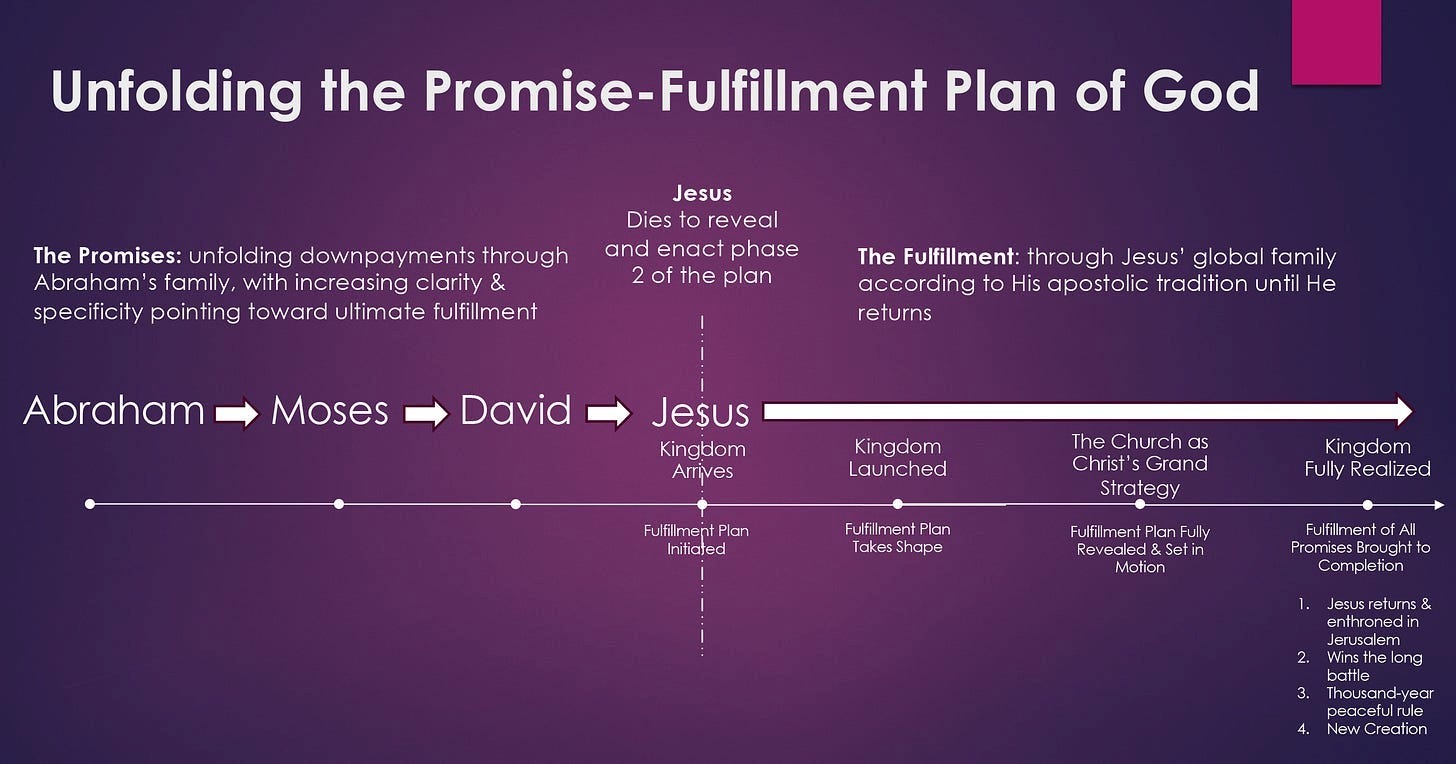
Secondly, we need to understand that the New Testament is actually organized around Christ’s plan, and how that plan was unfolded by the apostles in the first century.
Jesus intentionally held back and veiled His teaching while He was here, and then His Spirit fully revealed His plan to the apostles so that they could implement it throughout all the churches. This gives new insight and understanding of the letters of the apostles in the New Testament. That “New Testament” is the collection of the founding documents of the New Covenant, and they contain a unity and coherence through which they set forth the traditioning model (particularly through Paul’s writings) for the church for all time, until Jesus returns.
That unity can be understood by viewing the New Testament as a collection of writings organized around three key apostles and the church networks they were addressing.
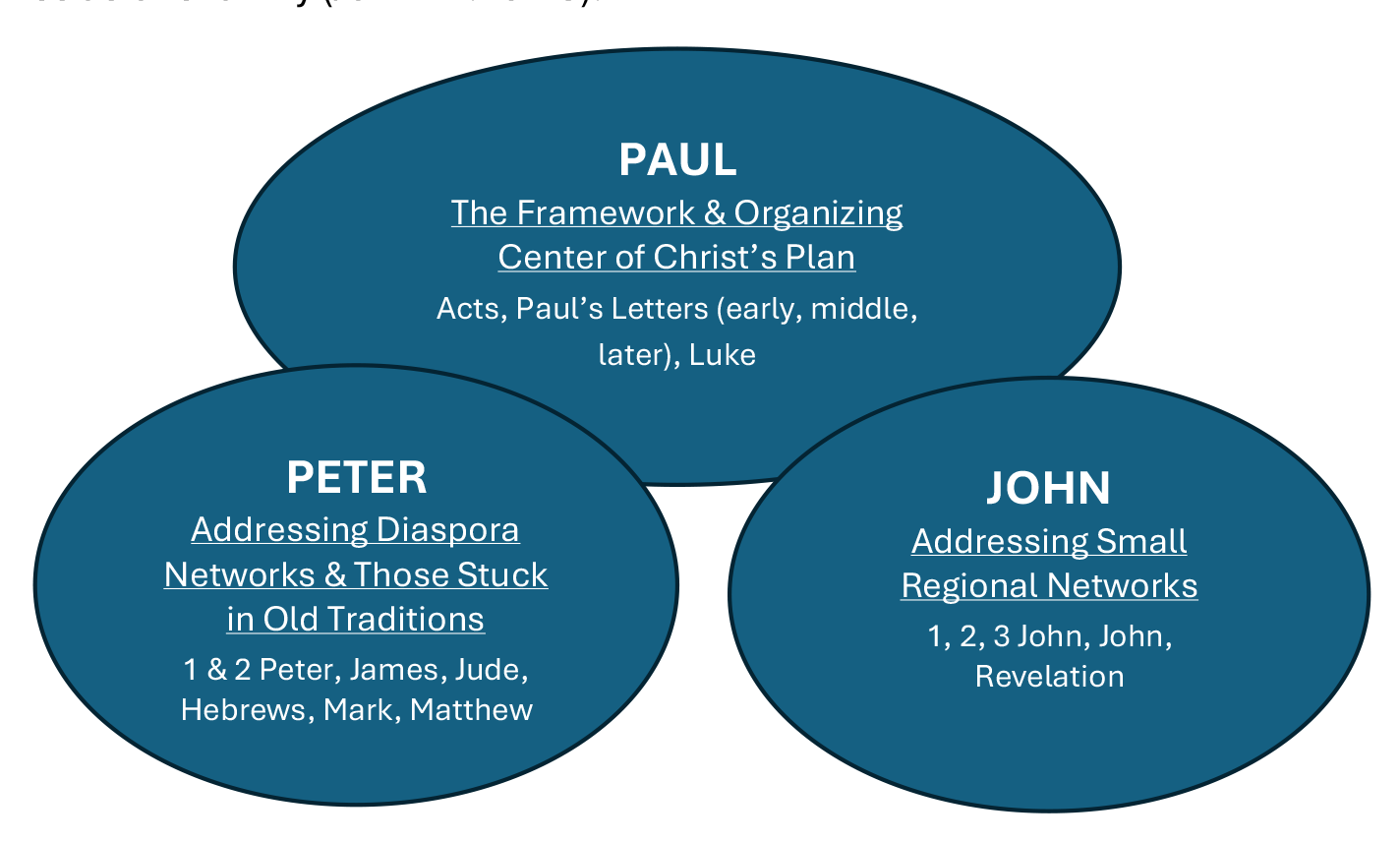
Paul’s role was central to establishing the tradition for all the churches, and the other apostles thought of Paul’s work and writings as authoritative3 and shaped their own work around Paul’s traditioning process and principles, in flexible ways across various networks of churches.
Below is the equipping tool it has taken me so long to introduce.4
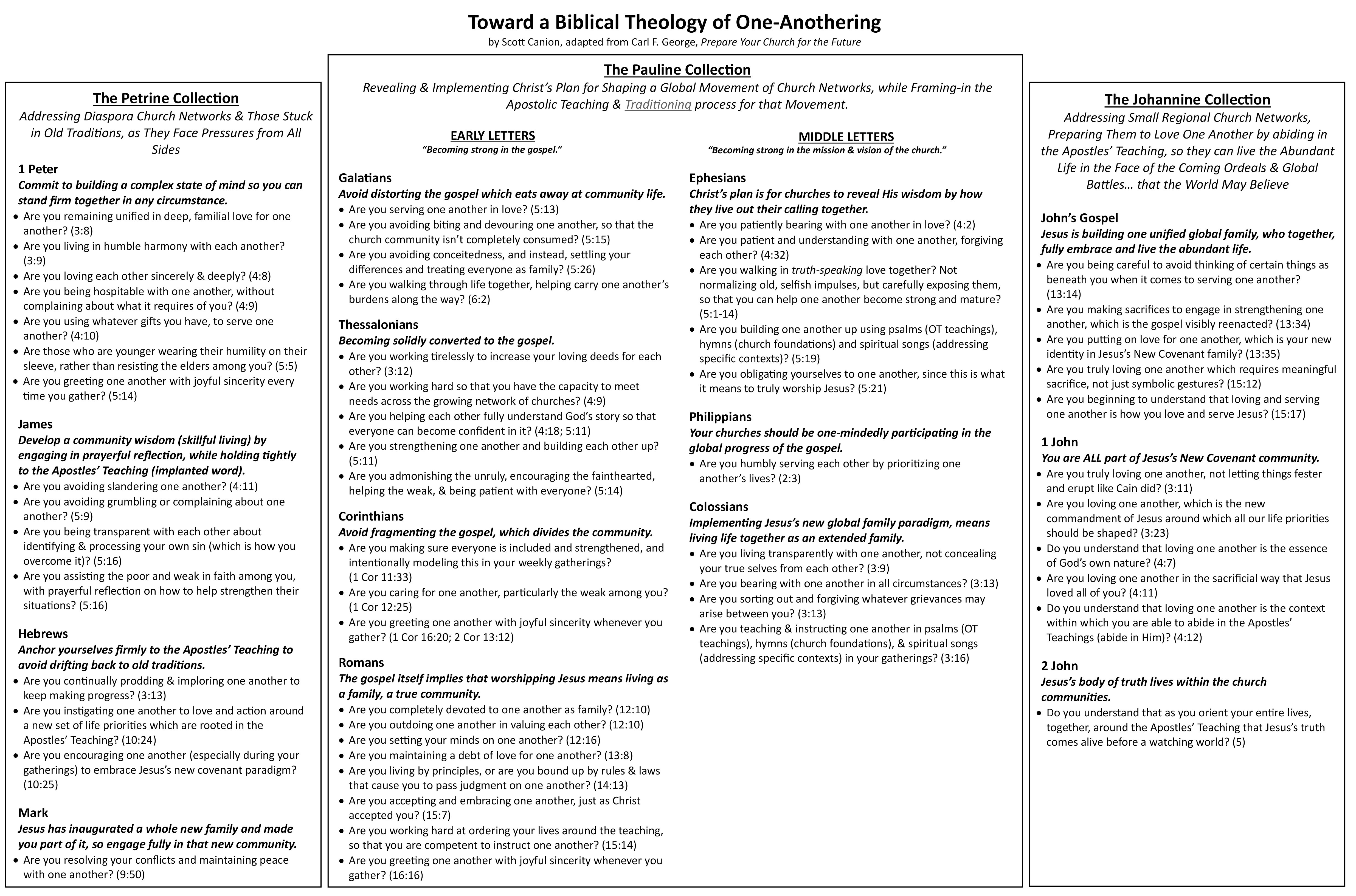
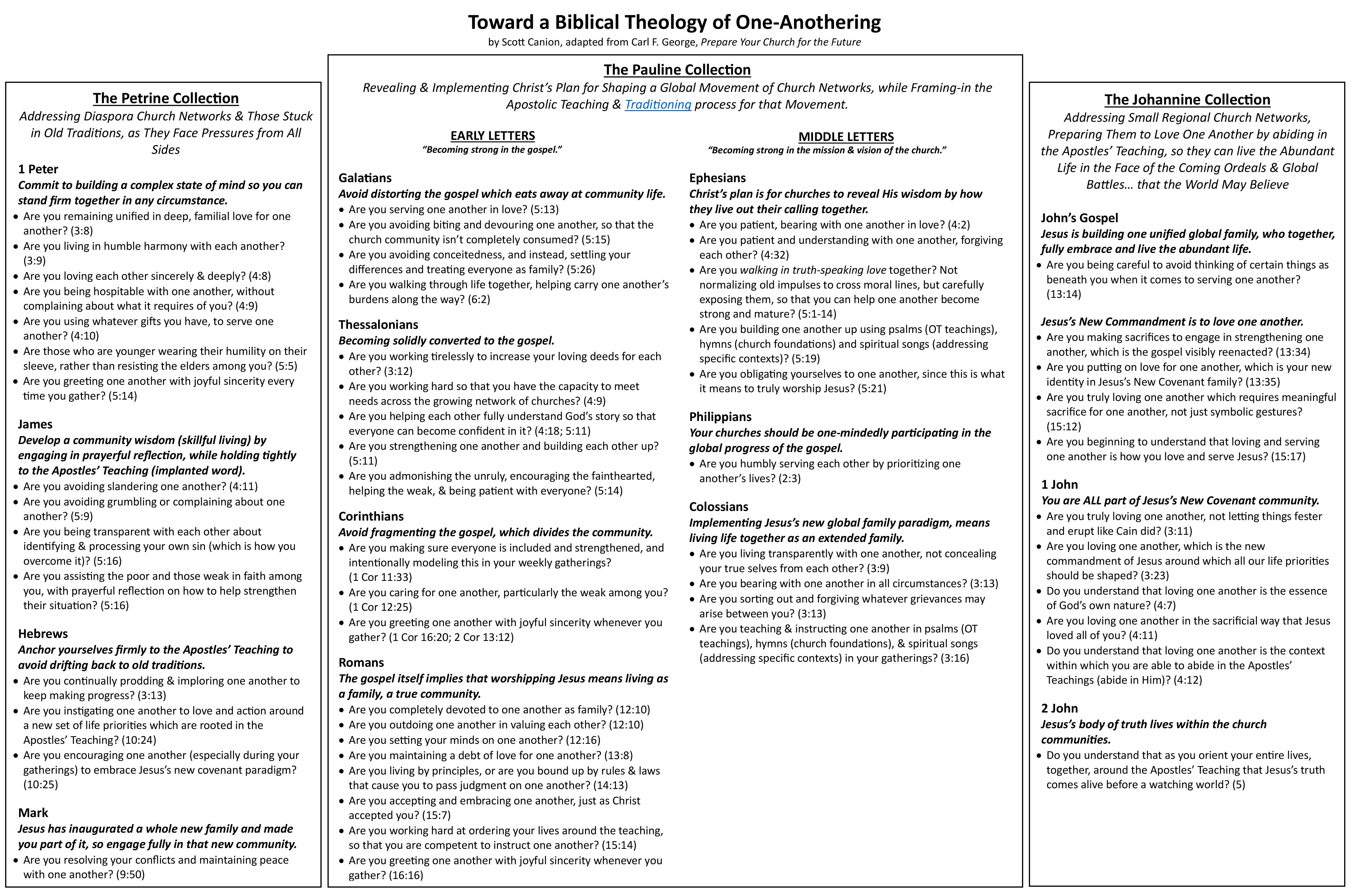
This tool is not a comprehensive look at the entire New Testament, but I have taken the 59 One Another passages from Carl George’s book and set them within their New Testament context, so that, rather than existing as a random list of how we should treat one another, you can actually see how they are part of the larger plan of Christ to shape His global family as networks of church families.
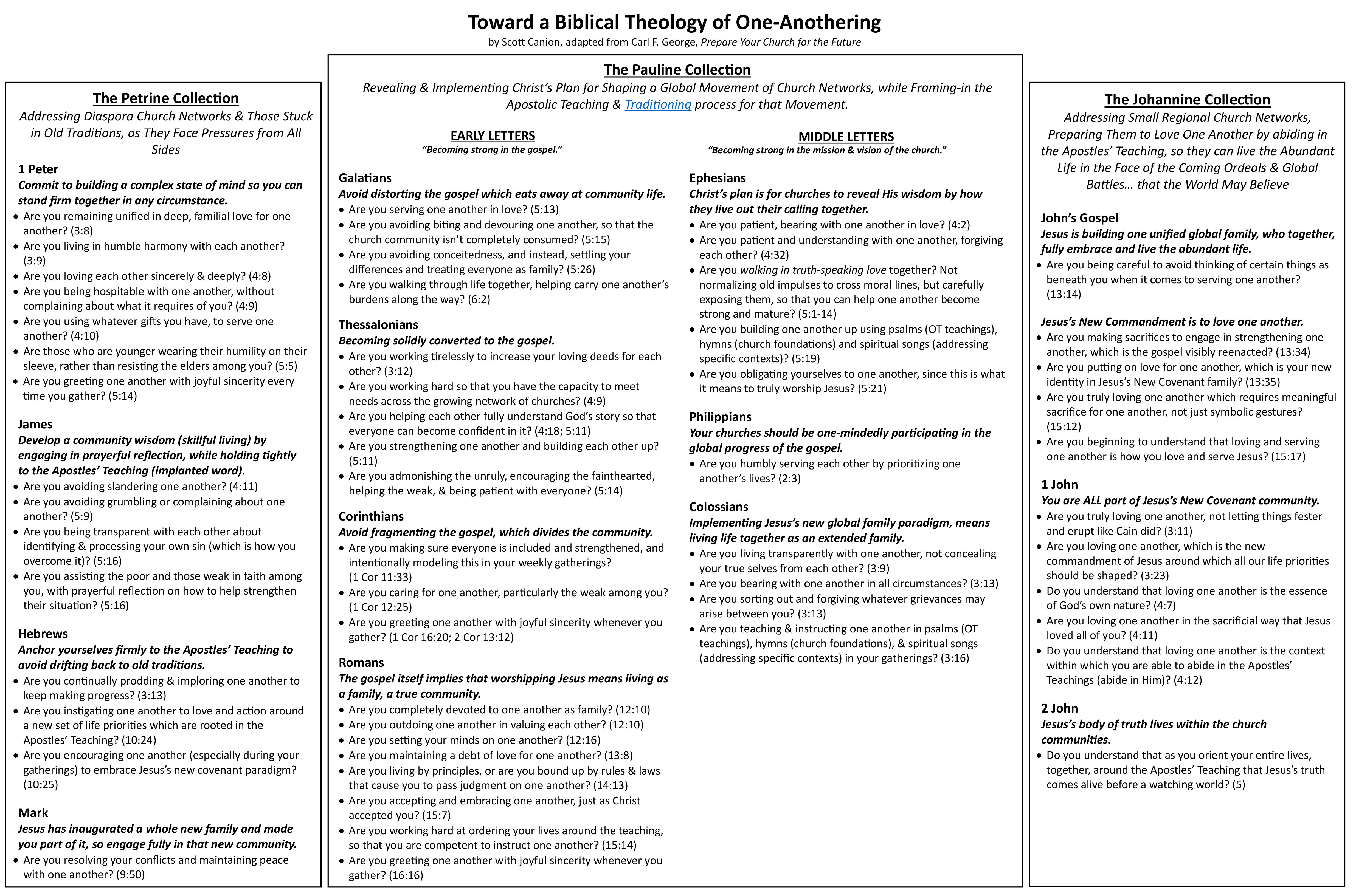
[This tool is adapted from Carl F. George, Prepare Your Church for the Future, The 59 One Anothers of the New Testament.]
One Anothering in the New Covenant Documents
PAULINE LETTERS
Paul’s Early Letters: “Becoming strong in the gospel.”
Galatians: “Why are you so quickly distorting the gospel, by adding to it? Instead, you should…”
Serve one another in love (5:13)
Stop biting and devouring one another, lest you completely consume each other (5:15)
Don’t become conceited, highlighting your differences, but instead treat everyone as family (5:26)
Walk through life together, helping to carry one another’s burdens along the way (6:2)
Thessalonians: “Becoming solidly converted to the gospel, will look like communities of believers that…”
Work tirelessly to increase your loving deeds for each other (3:12)
Love each other (4:9)
Encourage each other (4:18; 5:11)
Build each other up (5:11)
Admonish the unruly, encourage the fainthearted, help the weak, & be patient with everyone (5:14)
Corinthians: “Your fragmenting of the gospel is dividing the community, so instead….”
At your weekly gatherings, include everyone & build one another up (1 Cor 11:33)
Care for one another, particularly the weak among you (1 Cor 12:25)
When you gather, greet one another with joyful sincerity (1 Cor 16:20; 2 Cor 13:12)
Romans: “The gospel itself implies that the way you worship Jesus is to…”
Be completely devoted to one another as family (12:10)
Outdo one another in valuing each other (12:10)
Set your minds on one another (12:16)
Love one another (13:8)
Stop passing judgment on one another’s choices regarding matters of conscience (14:13)
Accept and embrace one another, just as Christ accepted you (15:7)
Teach, admonish, and correct one another (15:14)
When you gather, greet one another with joyful sincerity (16:16)
Paul’s Middle Letters: “Becoming strong the mission and vision of the church.”
Ephesians: “Christ’s grand strategy (His church) reveals His wisdom as they…”
Be patient, and bear with one another in love (4:2)
Be patient and understanding of one another, forgiving each other (4:32)
Speak to one another with psalms (OT), hymns (church foundations) and spiritual songs (addressing our situations) (5:19)
Obligate yourselves to one another as the way we worship Jesus (5:21)
Philippians: “Participating with one mind in the progress of the gospel, means that we should…”
Humbly serve one another, prioritizing one another’s lives (2:3)
Colossians: “Implementing Jesus’s new global family paradigm, means you should….”
Be transparent with each other, not deceptive or concealing your true thoughts and selves from each other (3:9)
Bear with one another in all circumstances (3:13)
Sort out and forge whatever grievances may arise with one another (3:13)
When you gather, teach & instruct one another in psalms (OT), hymns (church foundations), & spiritual songs (addressing our situations) (3:16)
PETRINE CIRCLE: “Addressing diaspora networks and those stuck in old traditions, as they face pressures on all sides.”
James: “The process for acquiring wisdom is asking God while holding tightly to the apostles’ teaching (implanted word) as you…”
Avoid slandering one another (4:11)
Avoid grumbling or complaining about one another (5:9)
Be transparent with each other about identifying & processing your own sin, which is how you overcome it (5:16)
Pray for, and assist, the weak in faith among you (5:16)
1 Peter: “Commit to building a complex state of mind so you can stand firm together in any circumstance.”
Remain unified in your deep, familial love for one another (3:8)
Live in humble harmony with one another (3:9)
More than anything else, love each other sincerely & deeply (4:8)
Be hospitable to one another without complaining about what it requires of you (4:9)
Use whatever gifts you have, to serve one another (4:10)
Wear your humility ‘on your sleeve’ with one another, rather than your egos (5:5)
At your gatherings, greet one another with joyful sincerity (5:14)
Hebrews: “Anchor yourselves to the apostles’ teaching to avoid drifting back to old traditions.”
Implore one another to keep making progress (3:13)
Instigate one another to love and action around a new set of life priorities rooted in the apostle’s teaching (10:24)
Encourage one another (especially during your gatherings) to embrace Jesus’s new covenant paradigm (10:25)
Mark: “The Announcement: Jesus has inaugurated a whole new family and made you a part of it, so…”
Resolve your conflicts and maintain peace with one another (9:50)
JOHANNINE WRITINGS: “Addressing small regional networks, preparing them to live abundantly in the face of the coming global battles.”
John’s Gospel: “Becoming one unified global family who, together, fully embrace and live out the abundant life, means...”
You should consider nothing as beneath you when it comes to serving one another well (13:14)
Loving one another is following Jesus’s example (13:34)
Loving one another is your new identity (13:35)
Loving one another means following Jesus’s sacrificial model (15:12)
Loving one another is how you love Jesus (15:17)
1 John: “You are ALL part of Jesus’s New Covenant, so...”
Love one another, don’t be like Cain (3:11)
Love one another, this is Jesus’s new commandment (3:23)
Love one another, because love defines who God is (4:7)
Love one another, because He loved all of you (4:11)
Loving one another is how you abide in Him (4:12)
2 John: “Jesus’s body of truth resides in the church communities.”
Jesus’s truth is made evident as you love one another (5)
Scott Canion is based out of the NYC area and is part of the METRO equipping team, a coalition of leaders who are establishing churches that are families, patterning themselves after Acts.
Kerygmatic Communities are churches who live as extended families, so that every aspect of their lives together are a visible proclamation of the gospel – which is the announcement that Jesus has initiated the fulfillment of the Old Testament promises to Abraham, Moses & David, and set in motion.
John 14:25-28; 16:12-15
2 Peter 3:15-16