

[This is shared from an ongoing conversation our church community is having about how to shape our lives together around Christ’s plan so that the very nature of our community life is a visible reenactment and reflection of the gospel (a kerygmatic community). We began our conversation with the topic of the meeting design of the early church, and quickly started bumping up against various traditions many of us have grown up with. The first of these is our concept of prayer. So we stopped to sidebar for a bit and explore how the early church engaged in prayer and what patterns were modeled for them as networks of churches were expanding across the Roman Empire in the first 35-40 years of Christianity and then how the gospel writers, near the end of the first century, paused to reflect on and record their understanding of their time with Jesus, in light of all that His Spirit continued to do through the Apostles, in the churches.]
Before we specifically focus in on the concept of prayer, let me set some context.
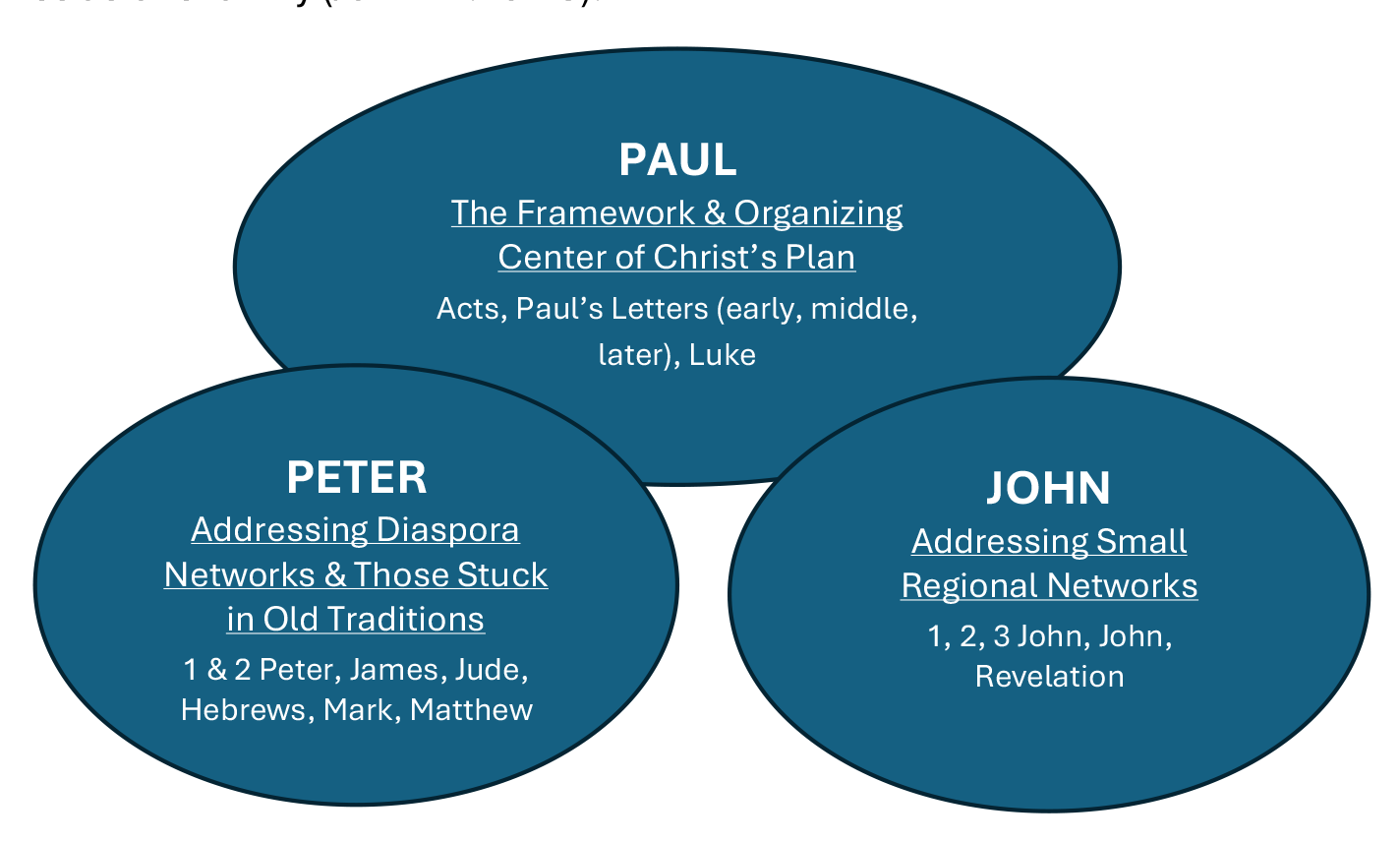
We must be able to hold the following framework in our heads to properly understand the New Testament.
Paul’s work was so important for Christ’s plan that Jesus made an “encore appearance” (Acts 9:1-19) to select him, commission him, and give him the specific stewardship to reveal and implement Christ’s Grand Strategy for all the churches throughout the Gentile world (Ephesians 3:8-12), while working to unite the Gentile and Jewish churches as one family (Eph 2; John 17:20-23).
“It is a totally different thing then, when you see the letters in the New Testament as abstract documents that are used to support existing systematic theological constructs [various religious traditions] versus understanding them as tools for establishing churches.” – Jeff Reed
The Letters of Paul as Establishing Tools
Early Letters:
Strong in the gospel. Organizing Center = Rom 16:25-27 “fully established in the gospel (Paul’s gospel), which is the gospel of Jesus Christ.”
Middle Letters:
Strong in the mission and vision of the church. Organizing Center = Eph 3:8-10 “bring to light what is the plan (grand strategy)”
Later Letters:
Strong mature households and leaders. Organizing Center = 1 Tim 3:14-15 “how people should behave in God’s household (family of families), which is the assembly of the living God”1
Prayer in Paul’s Middle Letters
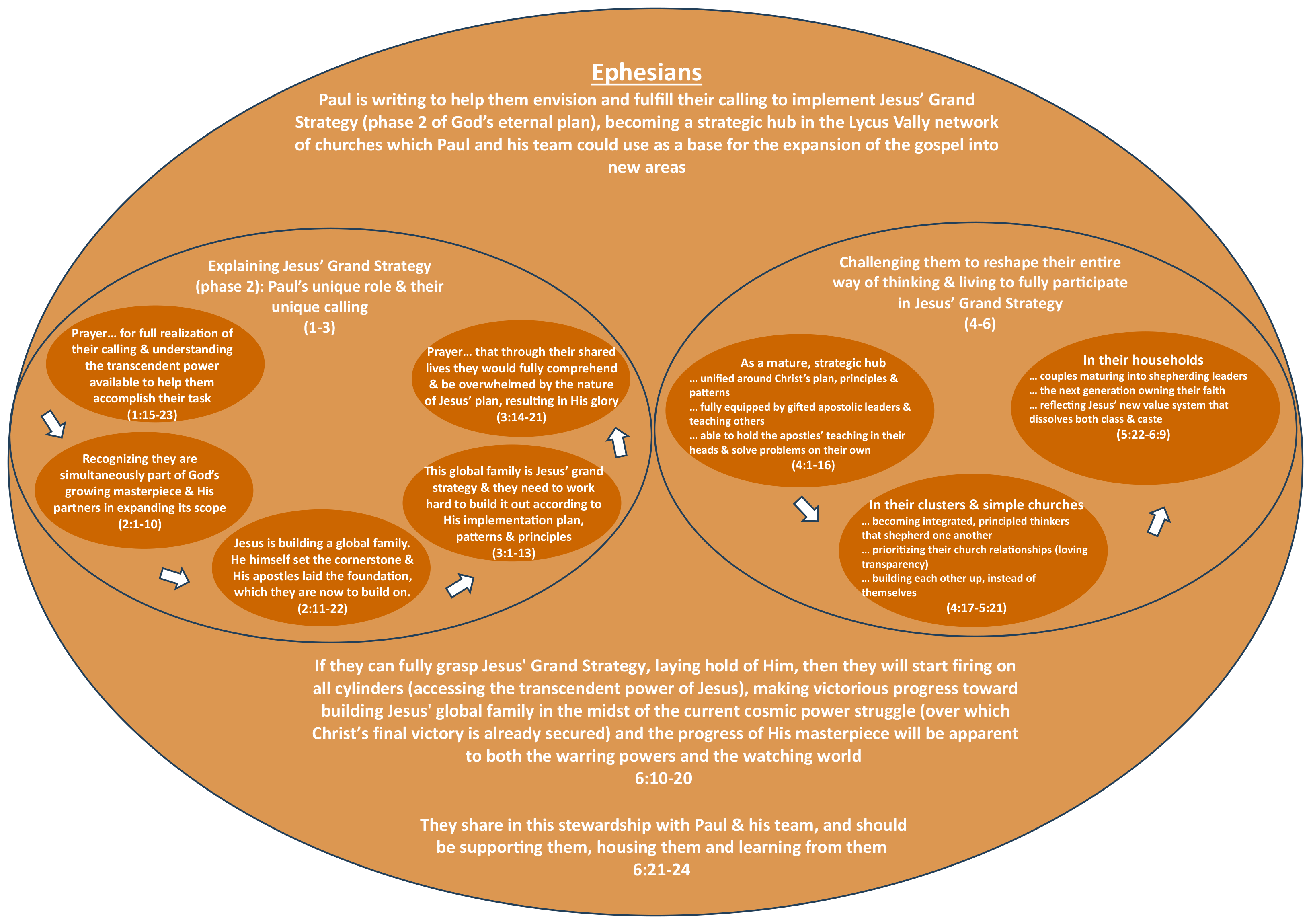
The two passages below, bookend the first half of the book of Ephesians, giving shape to its content and emphasis.
Ephesians 1:15-23
“For this reason, because I have heard of your faith in the Lord Jesus and your love toward all the saints, 16 I do not cease to give thanks for you, remembering you in my prayers, 17 that the God of our Lord Jesus Christ, the Father of glory, may give you the Spirit of wisdom and of revelation in the knowledge of him, 18 having the eyes of your hearts enlightened, that you may know what is the hope to which he has called you, what are the riches of his glorious inheritance in the saints, 19 and what is the immeasurable greatness of his power toward us who believe, according to the working of his great might 20 that he worked in Christ when he raised him from the dead and seated him at his right hand in the heavenly places, 21 far above all rule and authority and power and dominion, and above every name that is named, not only in this age but also in the one to come. 22 And he put all things under his feet and gave him as head over all things to the church, 23 which is his body, the fullness of him who fills all in all.”
Ephesians 3:14-21
“For this reason I bow my knees before the Father, 15 from whom every family in heaven and on earth is named, 16 that according to the riches of his glory he may grant you to be strengthened with power through his Spirit in your inner being, 17 so that Christ may dwell in your hearts through faith—that you, being rooted and grounded in love, 18 may have strength to comprehend with all the saints what is the breadth and length and height and depth, 19 and to know the love of Christ that surpasses knowledge, that you may be filled with all the fullness of God. 20 Now to him who is able to do far more abundantly than all that we ask or think, according to the power at work within us, 21 to him be glory in the church and in Christ Jesus throughout all generations, forever and ever. Amen.”
What falls between these two prayers in Ephesians?
In between the two prayers, Paul explains the significance of what Jesus has accomplished for God’s eternal plan (the joining together of Jews and Gentiles into one new family) and then explains that Jesus specifically selected him (Paul) as the one to reveal and implement His Grand Strategy in a way that would continue perpetually until Jesus returns (chapter 3).
Prayer #1: (Eph 1:15-23)
Paul prays that Jesus’ Spirit would help them continue to gain His perspective on the new paradigm Christ inaugurated and how His power is endlessly scalable in relationship to churches who pattern their lives around His plan (which Paul had spent three years teaching and modeling for them)… so they would come to fully grasp their strategic role in that plan as a key hub church in the region.
They need to recognize that they are simultaneously part of God’s growing masterpiece and also His partners in expanding its scope. (Eph 2:1-10)
They need to understand that Jesus is building a global family “the assembly of the living God” (1 Tim 3:14-15). He himself is the cornerstone and His Apostles laid the foundation, which they are now to build on according to His blueprint. (Eph 2:11-22)
This global family movement (initiated by Jesus and implemented by Paul) is Christ’s Grand Strategy and they need to work hard to build it out according to His implementation plan, following the patterns and principles Paul had taught them. (Eph 3:1-13)
Prayer #2: (Eph 3:14-21)
Paul prays that Jesus’ Spirit would help them become fully established and rooted in Christ’s plan (Jesus’ new paradigm), coming to fully comprehend the scope of it and engage in fulfilling their calling within it, as a key hub church in the region.
A Key Principle Emerges:
Prayer is about alignment. It’s about aligning our hearts with Jesus’s plan and the patterns and principles of that plan, which His Spirit revealed to the Apostles. As we work hard at this, in community, we will begin to comprehend the full scope and significance of His plan (Christ’s grand strategy.) However, making progress in it demands a focused, whole-life commitment.
The Prayer of Jesus included in Matthew’s Gospel
In Matthew’s gospel (written near the end of the first century after Paul & his team had established the Empire-wide network of churches) he records a prayer of Jesus which he (Matthew) now clarifies for us, having finally, himself, understood what Jesus meant at the time He prayed it. Namely, that what Jesus was praying for, was what had been taking place in the churches over the last 35 years and what Jesus expected to continue until He returned to complete things.
What is the essence of Jesus’ prayer (a.ka. the Lord’s prayer) that Matthew records in his gospel?
Another key prayer in the New Testament is the model prayer of Jesus that Matthew records in chapter 6 of his gospel. Let’s take a look at that in its context. I’ll break it down below.
'“Our Father in heaven, hallowed be your name…”
Acknowledging that God is the father of an extended family, which He is building according to His own plan and strategy. [“I will build my assembly and nothing will prevent it; and my Spirit will provide you with the keys for to how to accomplish this kingdom building work.” (Matthew 16:18; John 14:26)]
“Your kingdom come, your will be done on earth, as it is in heaven…”
Desiring and living within the economy of His new kingdom, within the tension of the current overlap of heaven and earth and the eventual joining of both in new creation; and ordering our lives according to this reality even now.
Accurately bearing the image of our Father as we carry out the task He has given us (the task which is made clear through the apostolic tradition), so that we are participating with Him in building His kingdom… His global family movement, while recognizing that ultimately, He sits in the control center of His creation.
“Give us this day our daily bread, and forgive us our debts as we also have forgiven our debtors…”
Humbly and repentantly loving God with all we have by extending the sacrificial love and provision He has given us, to one another, our neighborhoods, and our cities.
“And lead us not into temptation, but deliver us from evil…”
Asking for help to count the cost and faithfully engage in Christ’s plan (traditioned in the apostles’ teaching), working hard to develop complex states of mind, so that we don’t become captivated by the “ways of thinking” that define our cultures and/or religious traditions and thereby end up distracted from, or in unwitting opposition to, His plan.
Narratively, Jesus’ prayer in Matthew’s gospel anticipates Paul’s prayers in Ephesians, but historically Paul’s prayer informs Matthew’s gospel writing and helps make clear for him what Jesus was saying. Matthew records it in a way that helps us make the connection between the new kingdom plan Jesus inaugurated when he was here, and the plan that Paul implemented. In other words… they are the same plan.
Matthew is including this prayer after reflecting on it for several decades in light of what Jesus’ Spirit had revealed and accomplished through Paul and his team, who established an Empire-wide network of churches.
It is about being rooted and grounded in love for one another and fully participating in building His global family movement… His kingdom; it’s about churches figuring out their calling in that plan and then counting the cost and pouring their entire lives into fulfilling it… together.
The purpose of prayer is alignment. It is about reorienting our hearts to God’s plan so that we can become mature, confident, unshakable communities who are able to solve problems in our own situations; it’s not about asking Him to remove or smooth over the difficulties we encounter along the way.
Nowhere in the New Testament is prayer described as a means for requesting that God “deliver us from difficulty”, in fact it’s quite the opposite. Paul and Peter both spend a significant amount of ink telling the churches to remain steadfast in the midst of adversity, to become mature so they know how to process and respond to difficulty, and to help one another solve problems and find a way through them together. Nowhere does the New Testament teach that we should think of God as the “fixer” of our problems, but rather, as the One who has established a new community who endure them along with us. In 2 Corinthians 12:9-10, Paul goes so far as to say that without difficulty, we cannot make progress. It is by enduring trials together that we learn and become strong, solid communities. We know that Jesus will eventually abolish sickness and pain, but that comes at the end… at New Creation.
Let me be clear, remaining at a level of prayer which assumes that prayer is mainly about asking for problems to go away or get “fixed” is not what it means to show them love to others. It can actually be disorienting and cause them to misconceive of who God is. To paraphrase a portion of 1 Corinthians 13…
Love willingly takes on the burdens of others, and holds up through any frustrating or difficult circumstances those burdens might bring; it recognizes the potential in everyone and envisions them becoming mature, then it patiently engages and endures that process with them. Love doesn’t give up at the halfway point, it remains faithful to the end. Love is about helping others process their difficulties through the gospel, and becoming a stronger community because of that process.
Again, the point of all of this is to build strong church communities that share and learn together, making progress in their one-minded confidence and maturity, and becoming unshakable contenders for the faith in cities, across regions, and around the world.
[We spent a significant amount of time earlier this year focusing on the Sermon on the Mount and I did quite a bit of writing and teaching about it. That work provides a significant context for this conversation.]
Discussion Questions
What is the New Testament model for prayer according to Paul’s example and Matthew’s reflections on the prayer of Jesus? Why are there no instructions in the New Testament to ask God to remove suffering or difficulty (and only two brief examples)? What sort of things are we supposed to be praying for? How is this different from the “prayer tradition” most of us grew up practicing?
What is the role of prayer in fulfilling Christ’s Grand Strategy? Have we begun to fully comprehend Christ’s Grand Strategy, its scope, and our place in expanding that scope? How does prayer help accomplish this? What else is necessary to fully comprehend and accomplish it?
Based on your answers to the previous questions and the teaching above, how should we be practicing prayer in our homes? In our extended church families? In our gatherings? How can we practice prayer in a way that will deepen our understanding of and commitment to Christ’s plan?
Scott Canion is based out of the NYC area and is part of the METRO equipping team, a coalition of leaders who are establishing churches that are families, patterning themselves after Acts
Descriptions of Paul’s letters as establishing tools taken from the Comprehensive Assessment of Complex Apostolic Networks & Glossary tool by BILD International.