


Once again, I’m sharing from a conversation that our churches are having around 1 Corinthians 11:17-14:40. A question arose recently with regards to the way I paraphrased 13:3. We paused our conversation to stop and consider why my paraphrase was longer and more verbose than the way Paul wrote it. As we continue to talk as churches, I wanted to share where we are in that conversation.
“If I give away all I have, and if I deliver up my body to be burned, but have not love, I gain nothing.” - 1 Corinthians 13:3, ESV
Even if I give away everything I have and devote my entire life to helping the poor, destitute, and homeless, and willingly sacrifice my own life in the process, but have somehow missed the point that the weekly gathering is a reenactment of Jesus’ own loving sacrifice, meant to build up His family and be a visible witness that Jesus is King… then it’s all been for nothing. - My Paraphrase of 1 Corinthians 13:3 in the context of 11:17-14:40
Why is my paraphrase so wordy? Why did I include statements about the weekly gathering?
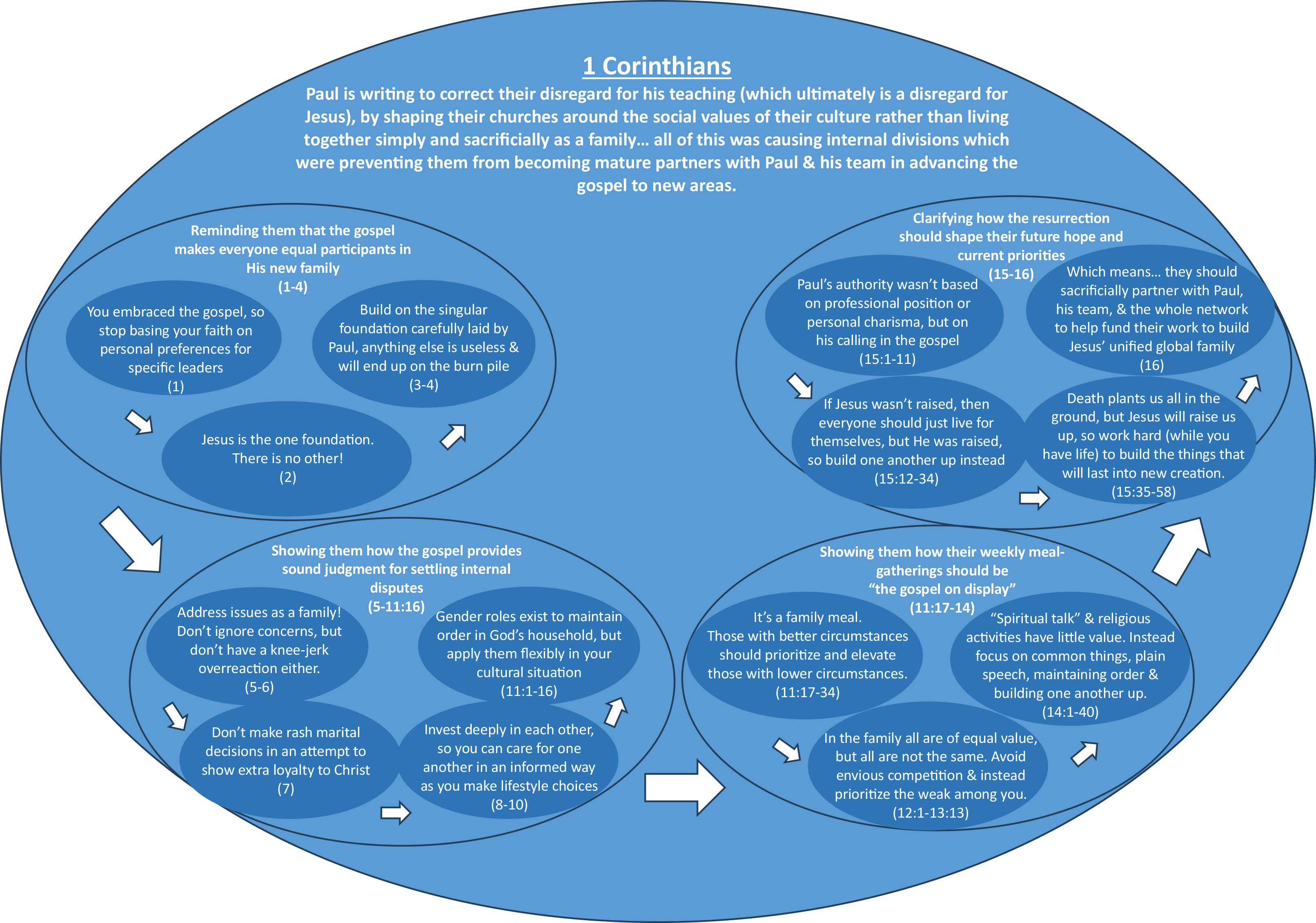
Because 1 Corinthians 11:17-14:40 is a “gathering text” topos. Let me pause and explain what I mean by topos. Many recognize that Paul and the apostles used “household texts” to address individual households, employing a topic-based formula (husband-wives, parents-children, masters-slaves - Eph 5:22-6:9; Col 3:18-24; 1 Pet 2:13-3:7) to carry weighted meaning and context. Paul uses these topos (think formulaic, topic-based passages loaded with meaning) over and over again in his letters, but they are difficult for us to recognize because over the centuries we’ve replaced them with our own theological categories, which we rely on as our own interpretive grid. In this “gathering text” in 1 Cor 11:17-14:40 (using a meal-symposium topos formula) Paul is explaining to the Corinthian church how their weekly gatherings should be the gospel on display. This organizational idea stands behind everything Paul is saying in these chapters (see my 1 Corinthians author’s intent on the last page).
We must keep the larger context in our minds (the forest) to accurately understand the details of specific verses (the trees) and we must be able to recognize the key topos passages, whose words and phrases carry organizing ideas that bear weighted meaning, and provide context for surrounding passages. When we just go verse-by-verse, or chapter-by-chapter, we completely miss the context of the author and their audience, and instead we end up assigning meaning from our own contexts, experiences and theological traditions. If we read 13:3 without understanding what was going on in Corinth and why Paul was writing this letter or without understanding the type of topoi he used, then it’s very easy to assume Paul is merely suggesting that as long as each believer has pure motives, we can all go around doing random good deeds on our own, or linking arms with others who want to do good deeds, and by doing this we have been obedient to this verse.
However, that is not what Paul is talking about here. He defines love in a very specific way for the Corinthian churches. He is talking about the deep family relationships that should shape their entire lives together, particularly as they gather each week for the Lord’s meal, to serve one another and build one another up in the apostles’ teaching. This is the way Jesus is building His global family.
So, the context for 1 Corinthians 13 is not romantic love. It’s not John Lennon-style love. It’s not about just doing good things with good motives or a general love for mankind. It’s about the sort of deep loving relationships that should define churches, which when practiced according to the pattern established by the apostles, are literally the gospel on display. Simple churches and clusters of churches enjoying their lives together, sacrificing for each other, prioritizing each other’s lives, and building one another up in the teaching, is itself kerygmatic, and the weekly meal-symposium gathering is the heart of that kerygmatic life together1… it is the irreplaceable context and source from which a life of loving good deeds emanates.
It is within the context of this sort of community life together that outsiders who know us will experience the gospel. They will see the gospel without necessarily realizing that’s what they are observing, and as we tell our stories and live this way, many outsiders who encounter us, will be attracted to this and want to join in. By experiencing a loving community, they come to love Jesus.
Simple churches and clusters of churches enjoying their lives together, sacrificing for each other, prioritizing each other’s lives, and building one another up in the teaching, is itself kerygmatic, and the weekly meal-symposium gathering is the heart of that kerygmatic life together… it is the irreplaceable context and source from which a life of loving good deeds emanates.
Not all good deeds go to heaven:
Not every good activity contributes to building Jesus' family. We have a near unlimited number of “good” choices set in front of us. We need to be selective about how we engage in good deeds in ways that will last into Jesus' kingdom when it is fully realized (new creation).2
There are tens of thousands of nonprofit organizations in the US, and while a great many of them help individuals with some aspect of their lives, almost none of them have a comprehensive vision for participating in building Jesus' global family.
We must discern between emotional appeals and genuine opportunities.
Good deeds done for appearance’s sake, due to cultural pressure or to gain favor/status with others, cause division and schisms in our churches.
Good deeds done to make us feel good about ourselves tend in one of two directions, either they become an obsession that takes over our lives, or they exist as token opportunities that allow us to check a box, feel good, and move on. Either way, they cause us to place Jesus’ plan and our own church families secondary to our personal charitable activities and interests.
Random acts of kindness vs. targeted household plans:
Paul is not saying don't engage in good works. Paul is saying do the things that build Jesus' family and will last into new creation.
Good deeds need to be done as part of a series of nested strategies: a household strategy, a church family strategy, a global team strategy, and Christ's grand strategy.
We need discernment about when to engage in meeting pressing needs or pursuing spontaneous opportunities that arise. If we are ordering our homes and churches around Christ's plan and principles, then our very lives together and our growing spheres of relationships become the opportunity (not merely a means to an opportunity)
We need a shepherding plan for those that come into our churches needing assistance with getting their lives back on track and stabilized, so that they are able to become mature fully-functioning members of the family
Random deeds and chance encounters should not dominate our approach, but that doesn’t mean we should throw them out entirely. This is why we have one another, to help think things through and make good decisions together.
We must be able to determine at what point our investment in ongoing situations might be enabling someone to avoid taking ownership of their own life circumstances or might be consuming so much of our resources that we are then unable to help others who may be sincerely trying to stabilize their lives so that they can become a mature, productive part of the local community.
These things should regularly come up in conversation in our weekly gatherings with one another (and in our leadership equipping times), so that we can help each other think things through, becoming a transformed, one-minded community who are able to interpret the complexities of our lives through the gospel
Good deeds done to make us feel good about ourselves tend in one of two directions. Either they become an obsession that takes over our lives, or they become token opportunities that allow us to check a box, feel good and move on. Either way, they cause us to place Jesus’ plan and our own church families secondary to our personal charitable activities and interests.
Created For Good Works: An Integrated Approach
Good deeds are not a specific category of activities we engage in, they are what God designed us for, and understanding His story and our place in that story is critical for recognizing what a “life of good deeds” looks like in our time and culture (Eph 2:8-10)
Good deeds include our paid work and the roles and responsibilities we have in those situations and should shape how we approach our work, jobs, careers and the authority relationships present in those situations (Eph 6:5-9)
The idea of good works means approaching all of our work with a disciplined work ethic that is shaped by an understanding of Jesus’ plan and our calling as households and churches, then setting our priorities from that vantage point (1 Thess 4:11-12; 2 Thess 3:6-15)
Good works includes organizing our finances, budgets, and savings so that we can give proportionally, with vision and passion, and at times sacrificially to meet pressing needs in our communities and participate as a global movement in the work of building Jesus’ global family (2 Cor 9:6-9)
Good works are not just certain occupations we engage in, but are part of our calling within the plan of God, so we should take a robust, comprehensive approach to good works that orients our entire lives, rather than just token involvement based on the priorities and pressures of our culture and its institutions (1 Cor 9:24-27)
Jesus already completed the ultimate loving “good deed” to inaugurate His new family, and then He left us His plan for how that family should live so that it would continue to expand to all the peoples of the world. Our lives, and particularly our weekly meal-symposium gatherings, are the visual testimony and reminder that Jesus’ sacrifice continues on in the family He is building, as we sacrifice for one another, and together for our neighborhoods and cities.
We are either following that plan and building on the foundation laid by the apostles, or we are doing our own thing and building on some other foundation.
Questions:
Why do we tend to gravitate toward random, unplanned acts as if they are more sincere or meaningful than planned, strategic acts? Is this a cultural idea that we have adopted?
How has the institutionalization of good deeds (NGO’s, nonprofits, relief & development organizations) affected our perspective on the “life of good deeds” concept Paul is working from?
How is the weekly meal-symposium gathering the heart of all our good works? How is it the central context for where good deeds are practiced, and from which all good deeds emanate?
How do simple churches and clusters of churches act as a base for a life of good works that will significantly impact their communities, while functioning as benefactors for the global work of church multiplication? What might it look like for churches and networks of churches to steward their collective resources in a way that makes it possible for them to have significant impact in both areas?
What would it look like to have a household plan that includes intentional good deeds? Plans and strategies as churches and networks? All of which dovetail with the focus of a global team of leaders who are shaping churches around Christ’s plan? What are the implications of each of us just doing this on our own, rather than as part of a larger plan?
Kerygmatic life together is a way of describing the transformed way the early churches lived together, which was the basis for the tradition Jesus’ gave Paul which was to be passed on and implemented in all churches and clusters of churches until He returns. Their life together was their visible witness that the gospel had revealed a new family and a new reality so that both the watching world and warring spiritual powers would see the wisdom of God’s plan displayed in front of them (Eph 3:8-10). Their lives together were kerygmatic in…
They were kerygmatic in their meeting design.
They were kerygmatic by the change in their lives.
They were kerygmatic by the quality (and design) of the community life.
They were kerygmatic as they told their stories.
They were kerygmatic in their participation in the regional multiplication of churches.
They were kerygmatic in their participation in the global progress of the gospel.
This concept emerges from an understanding of God’s Story. The entire story is leading up to Jesus’ family ruling with Him over the new creation. If the good deeds we are doing are not contributing to building Jesus’ kingdom, then we are just spinning our wheels, and we could end consuming all our time and resources on things that will burn-up on entry into new creation.
Scott Canion is based out of the NYC area and is part of the METRO equipping team, a network of global leaders who are establishing churches that are families, patterning themselves after Acts.