


[The purpose of this short paper is to help stabilize the churches that I oversee, helping them develop the ability to “contend for the faith” by fully understanding Christ’s Grand Strategy and practicing The Way of Christ and His Apostles in light of the pervasive “religion of the day”, which deceptively presents itself as various “enlightened pathways” but which ultimately lead believers toward Moralistic Therapeutic Deism (MTD) or an emphasis on the emotional payoff of “doing the right thing” or being “on the right side of history”. Christians who don’t yet have a solid understanding of the entire Scriptures or a confident ability to use them to solve complex problems, can find it difficult to discern the subtle heresies of this “religion of the day”, because of the complex way it weaves bits of truth into its philosophies and agendas. It is Gnostic at its roots, meaning its premise is… unquestionable exclusivity, cosmic mystery and hidden truths. Those who subscribe to its various forms pride themselves on being an enlightened minority and often behave in misanthropic ways toward the rest of society. These religions of the day are powerless to help us accomplish Christ’s plan. They create a distraction and have the potential to destabilize whole families and churches if not addressed quickly, thoroughly, and frankly. – Titus 1:7-16.
A note on contending for the faith. While the word contending can include a reference to “contention” or arguing, I am mainly focused on the idea of “competing to win”, like one who is a contender amidst stiff competition. The reference is more about the hard work, training and full-life commitment it takes to win the arguments in our shifting cultural and theological paradigms.]
What do I mean by the “religion of the day”?
I am referring to a concept highlighted in a recent book of the same name. The Religion of the Day, by James P. Shea, which critically examines the prevailing secular ideologies that function as quasi-religious systems in contemporary society. The book urges Christians to recognize and resist the subtle encroachments of these modern belief systems.
The book argues that contrary to the assumption of a secular age devoid of religion, we are immersed in a highly religious era where secular "gospels" and dogmatic faiths abound. These belief systems—centered on ideologies such as radical individualism, materialism, and relativism—offer their own narratives of salvation and purpose, effectively displacing traditional Christian narratives. They promise fulfillment and meaning but often lead to disillusionment, as they lack the depth and transcendence found in the Christian faith. In other words, they are telling and promoting other overarching stories, other metanarratives.
In his 2024 end-of-year letter, sent to Mars Hill Audio Journal subscribers, Ken Myers quotes the theologian Simon Oliver:
The secular is not simply the rolling back of a theological consensus to reveal a neutral territory where we all become equal players, but the replacement of a certain view of God and creation with a different view which still makes claims, that is, claims about origins, purpose, and transcendence. The problem is that this ‘mock-theology’ or ‘pseudo-theology’ is a bad theology. Secularism is, quite literally, a Christian heresy - an ideological distortion of theology. - Ken Myers
Another helpful way of thinking about this is…
Attractive gospel messages abound and many Christians find their identity and purpose by aligning themselves with things like health, diet, gender, materialism, politics, policy, race, financial concerns, their nation, their candidate, etc., with all of this flooding people’s minds every single day.
Every individual is constantly telling themselves things. Your mind is actively building a narrative that speaks deeply into your soul. A key part of building a complex mental state is to discipline your mind to consistently recognize the lies you will tell yourself, and then replace those thoughts with the truth of the Bible, and then from others around you. - Michael Vos
It is critical that we understand God’s overarching story as the true story that gives meaning to human existence, a story based in actual human history, not in inventive, fictional nonsense or skeptical, jaded narratives. Christians must rediscover and internalize this narrative to effectively counter the false promises of the "religion of the day." This involves a deep personal conversion and a commitment to living out the truths of the gospel in daily life as part of a simple church family, who is in turn are part of a larger family network, a family of families.
Christian households and kerygmatic communities1 should be engaging with the culture not retreating into nostalgia or despair but confidently bearing witness to the transformative power of the Spirit’s work, which we understand happens when we follow The Way of Christ and His Apostles2 (TWCA) and live together as simple church families. The author draws inspiration from the early Christian communities, who, despite being a minority in a pagan society, lived with conviction and hope, believing in their role within God's salvific plan.
In conclusion, The Religion of the Day serves as a call to action for Christians to recognize the pervasive secular ideologies that wear religious clothing, presenting subtle, enticing alternatives to genuine Christian faith; and a call for Christians to respond with a renewed commitment to the gospel (kerygma). By embracing their identity as part of Jesus’ global family movement and living out the Christian narrative authentically in community, believers can offer a compelling alternative to the empty promises of contemporary “religious secularism”.
Four Contemporary Examples of “the religion of the day”
The “religion of the day” can take many forms, even forms that seemingly stem from opposing ideologies. However, they all attribute aspects of transcendent meaning to various cultural values systems and then attempt to shape communities and movements around those systems, some of which also hybridize with existing religious traditions. Others attempt to retain a strictly “secular” set of priorities. However, all of them function as religions in the sense that they attempt to provide moral purpose, identity, a sense of community and a mission.
Example #1: Jonathan Cahn and Hope of the World End-Time Ministries
It is difficult to discern Jonathan Cahn’s motives simply by reading a couple of his books, but my overall take is that Cahn started out as a sincere follower of Jesus, who was trying to reconcile the significance of Israel in the story of the Bible against the seeming insignificance afforded it by Christendom (Western churches and theological institutions). However, it seems that somewhere along the way, Cahn has become enamored by his own ideas and successes, and now functions with a dual-purpose of delivering his message of warning and driving his personal (financial and institutional) success by constantly raising the stakes of the narrative he is constructing, connecting specific Old Testament events and prophecies to specific current events, people, and politics. He relies heavily on rhetorical skill and personal charisma, both of which are cultural currency in America. All this together affords him the ability to explain, or explain away, without giving a robust, hermeneutical basis for his teaching.
In particular, Cahn seems confused about the role of the gospel in God’s overarching story. He often stretches and tugs at biblical passages to make them fit over the story he is telling.3 His effective use of storytelling, evocative descriptions and inventive metaphors feel fresh and exciting to those who are not solidly grounded in God’s overarching story and the full text of Scripture. Cahn is an effective communicator, and likely a sodality-type, but not true apostolic leader. Paul warns the Corinthian church about such teachers in 2 Cor 11-12, and he clarifies that the signs of a true apostolic leader are careful teaching, powerful hermeneutically-sound arguments, life-on-life modeling, significant personal sacrifice and the resulting community transformation that takes place over an extended period of time, which is achieved only with the utmost patience and depth of relationship.4 Cahn is not engaged in the sort of work Paul described here. Instead, his work is built around sensationalism, personal charisma, and tapping into the anxieties of his audience, leading them to believe those anxieties can only be relieved by following his teaching and engaging in certain civil or political behaviors.
Because Cahn has misunderstood God’s Story, particularly the turning point of the gospel, he then has no basis for understanding Christ’s Grand Strategy5 or The Way of Christ and His Apostles, which if understood properly could undo much of Cahn’s confusion about the overlap of the transcendent and the immanent. Because of this, Cahn also misunderstands the role of the Spirit today. He doesn’t understand that in this age, Jesus’ Spirit primarily works via networks of simple churches who live as extended families and gather weekly in homes for a meal and discussion, who invest sacrificially in their neighborhoods and cities; and that the Spirit also works to spontaneously shape these sorts of simple churches in places where none yet exist or where there are no true apostolic-type leaders to initiate those networks.
Cahn’s Nostradamus-like approach is attractive to those who resonate with hidden meanings, secret knowledge, and conspiracy theories. Secret knowledge is attractive because it makes a person feel like they are part of a special group who are “in the know”, but it is especially dangerous because it can’t be easily refuted, since it is based on secret ideas and meanings thereby avoiding interaction with rational logic or reason. Those that attempt to refute it are generally dismissed as “unenlightened”. Secret knowledge relies on a superstitious metaphysic; a misconstrued understanding of how certain things transcend the material world. Strong beliefs are then formed by assigning transcendent meaning to specific events or people and all those disparate ideas and bits of random information are then pieced together into a mosaic, which supposedly reveals some grand scheme that must be adhered to or opposed. Secret knowledge has no overarching framework or organizing center, so there is nothing to keep someone from constantly rearranging its pieces, morphing into a grander, higher stakes situation; there is no larger concept that organizes all the bits of knowledge in a cohesive and orderly way.
[Cahn is not the only outlet for this sort of religiously-cloaked ideological fervor, sensationalism, or loose, freewheeling “hermeneutics”. These type of media outlets, are too numerous to count, but one that stands out, based on its popularity, longevity, and name recognition, is CBN and its entire catalog of media products (700 Club, CBN News, etc.) Ad Fontes Media6 produces and regularly updates an online media bias chart (placing CBN well outside of the sphere of unbiased reliability), which is helpful for determining reliable news sources, but it does not account for what I call the “red letter effect”. That by using religious jargon in a headline or at the beginning of an article, a writer can activate an automatic response of trust from certain individuals making them more susceptible to false ideas; or that by tying the ideas in an article to religious terms or phrases, a writer can lower the defenses and capture the trust of certain religious people who intuitively believe that if an author is using familiar religious terms, then they must be reliable.]
To summarize, Cahn misunderstands key elements of Christian theology, particularly God’s overarching story, the kerygma, and the role of the Holy Spirit. He promotes a blend of sensationalism, conspiracy thinking, and pseudo-Jewish Christian practices drawn from movements like the Hebrew Roots7, New Apostolic Reformation8 and Dominionism9, all of which he has used to build his own following made of converts who generally come from one of these three philosophies. (All three philosophies were birthed out of the 1980’s “late, great planet earth” prophecy panic.) Cahn seems to be taking a page out of that 1980’s conspiracy/prophecy playbook (e.g. Hal Lindsey, Frank Peretti, etc.) His books alternate between novels and non-fiction style messages that are self-reinforcing but never transparently lay out a clear framework for his message. Acting as if he is a human “Rosetta stone” for biblical prophecy, his appeal lies in his claim that he can explain the hidden meanings of the Scriptures, which can be dangerous because his explanations resist rational critique and lack a coherent theological framework.
Cahn's works play on existing anxieties, stir up urgency and stoke dissatisfaction and frustration with the state of society, culture and politics, rather than focusing on Christ’s actual strategy—simple churches living in community and multiplying organically via kerygmatic communities who both contribute to and are birthed out of the intense work of apostolic leaders. Cahn operates by manipulating emotions through dramatic language and misleading believers into civic religion and political action rather than faithfulness to Christ’s plan.
Example #2: Falun Gong, The Epoch Times, and Shen Yun
Falun Gong is a spiritualistic movement begun in the early 1990’s and controls both The Epoch Times and Shen Yun, using those outlets as its public voice, to create a cultural identity, and fund its organization.
The relationship between Falun Gong, the Epoch Times and Shen Yun.
Falun Gong (Falun Dafa):
Founded by Li Hongzhi in China in the 1990s, Falun Gong is a spiritualistic movement combining meditation, qigong exercises, and a moral philosophy rooted in truthfulness, compassion, and tolerance.
Though it incorporates some traditional Chinese religious and cosmological elements, Falun Gong also includes unorthodox beliefs and promotes Li Hongzhi as a messianic figure.
The Chinese government banned Falun Gong in 1999, labeling it a dangerous cult.
The Epoch Times:
The Epoch Times is a media outlet founded by Falun Gong practitioners in 2000.
Though it presents itself as an independent news organization, it promotes Falun Gong ideology and often publishes conspiracy-laden or far-right-leaning content.
It played a major role in spreading pro-Trump and QAnon-related narratives, especially during the 2020 U.S. election and COVID-19 pandemic.
Shen Yun Performing Arts:
Shen Yun is a dance and music company created by Falun Gong adherents.
It markets itself as a celebration of traditional Chinese culture, but performances often include underlying religious and political messages aligned with Falun Gong’s worldview, including anti-Communist and apocalyptic themes.
Its marketing is extensive and global, often criticized as misleading because the show is advertised as purely cultural while it is actually ideological.
How Falun Gong acts as a Secularized Religion of the Day:
Cultic Characteristics:
Leader Adoration & Reverence: Li Hongzhi is treated as an enlightened being with near-divine status. His teachings are considered infallible, and followers believe he can save humanity.
Us-vs-Them Mentality: The movement frames itself as persecuted by evil forces (primarily the Chinese Communist Party), encouraging a siege-mentality among followers.
Secrecy and Indoctrination: While Falun Gong presents itself as a benign spiritual practice, deeper teachings are often revealed gradually, and outsiders are not given the full picture upfront.
Modern Appeal as a “Religion of the Day”:
Falun Gong’s media arms and performance arts exploit secular aesthetics (e.g., journalism, entertainment, wellness) to spread spiritual ideology, making it appealing in a time when traditional religion is in decline.
This positions Falun Gong as a pseudo-secular faith: it offers meaning, purpose, and an identity to adherents, while often cloaking itself in non-religious or even scientific terms (especially in its health and meditation claims).
It capitalizes on Western disenchantment with materialism, modernity, and government overreach, but replaces religion with a mythologized anti-modernity that has its own orthodoxy, enemies, and eschatology.
Danger in Secular Trappings:
Movements like Falun Gong can masquerade as cultural or health-based, avoiding the scrutiny typically applied to organized religion or cults.
The conflation of political activism, spiritual salvation, and conspiratorial thinking creates an emotionally charged but intellectually shallow system—a secular cult in religious clothing, a perfect example of the “religion of the day”.
The media and entertainment arms (Epoch Times and Shen Yun) blur the lines between truth and propaganda, contributing to the post-truth landscape under the guise of “spiritual revival” or “cultural restoration.”
In conclusion, Falun Gong, through its subsidiaries like The Epoch Times and Shen Yun, presents a hybrid of spirituality, political activism, and media manipulation that reflects the modern craving for meaning and identity. It mirrors institutional religion’s structure but trades theological depth for ideological fervor. This makes it less a traditional religion and more a response to secular disillusionment, cloaked in the aesthetics of culture, reason and spirituality.
Example #3: Critical Social Justice (CSJ) and Unitarian Universalism
Beyond formal religion, many critics (John McWhorter) argue that Critical Social Justice (CSJ)—an ideology rooted in intersectionality10 (theory of discrimination), critical theory11, and postmodernism12—functions as a secular religion.
Whether it's Unitarian Universalism as an organized religion, or Critical Social Justice as a cultural belief system, both demonstrate how progressivism can become a form of spiritual identity—complete with its own theology, rituals, and moral absolutes. While it is often rooted in noble aims (justice, dignity, inclusion), the danger lies in replacing transcendence with ideology, and grace with guilt or performance.
Critical Social Justice (CSJ), while presented as a secular sociopolitical movement, increasingly functions like a religious framework—complete with its own moral code, dogma, liturgy, and vision of salvation. Under the banner of equity and justice, CSJ offers a totalizing worldview that defines identity, sin, righteousness, and redemption in explicitly moral—and often metaphysical—terms, despite lacking any transcendent foundation. This cloaked religiosity makes CSJ both persuasive and dangerous, especially when it supplants traditional religious beliefs while denying its own religious nature.
At the heart of CSJ lies a redefinition of religion around the categories of Christian systematic theology, such as sin, salvation, evangelism, etc. Traditional religion identifies sin as rebellion against divine authority or a violation of moral law. CSJ reframes sin as participation in oppressive systems, especially those defined by race, gender, sexuality, and class. “Original sin” becomes whiteness, patriarchy, heteronormativity, or cisgender identity—conditions a person is born into and cannot shed, only “acknowledge.” Likewise, “salvation” is no longer personal transformation or reconciliation with God, but the continual work of anti-racism, allyship, and deconstruction of privilege. This salvation is never complete; adherents must constantly confess, self-examine, and engage in activism to maintain moral standing.
“Progressive religion, on the other hand, claims to be able to divide the human race between the good and the evil in the present, and it places the authority to make such judgments in the hands of other (enlightened) humans.” – The Religion of the Day, pg. 41
Like religious orthodoxy, CSJ enforces doctrinal purity. Dissenting views are heretical, regardless of intent or reasoning. Those who question its tenets—whether from within or outside the movement—are often labeled as bigoted, ignorant, or complicit in oppression. “Silence is violence,” a common CSJ mantra, serves as both theological accusation and moral compulsion. In this sense, CSJ is not merely a social theory but a belief system that demands conformity and punishes apostasy.
Moreover, CSJ offers its own clergy and sacraments. Diversity, Equity, and Inclusion (DEI) officers function as modern-day priests, guiding institutions through rituals of self-purification and ideological compliance. Terms like “safe spaces,” “lived experience,” and “microaggressions” form a shared language—a kind of liturgy—that binds the community together. Canonical texts such as White Fragility and How to Be an Antiracist are treated as sacred writings, while public apologies and statements of solidarity act as confessions and penance.
What makes CSJ particularly troubling is its lack of an overarching framework rooted in objective truth or grace. It demands absolute adherence without offering a coherent metaphysical basis for why its moral claims should be universally binding. It replaces forgiveness with perpetual guilt, and grace with performance. There is no possibility of redemption outside the system—only endless striving. Furthermore, its framework flattens individuals into identity groups, reducing human beings to power categories rather than seeing them as morally complex individuals, communities and civilizations.
Ultimately, CSJ disguises itself as a secular effort for justice while performing the functions of a rigid and moralistic religion. It fills a spiritual void in our post-Christian culture but offers no transcendent hope or true reconciliation. Its justice lacks mercy, and its gospel lacks grace. Without acknowledging its religious nature, CSJ can quietly usurp genuine faith communities, replacing the gospel of Christ with a gospel of activism, identity, and unending penance. Recognizing this substitution is the first step toward resisting its influence and reclaiming the fullness of a faith rooted in truth, love, and redemptive grace.
Example #4: Prosperity Theology, Healing Ministry, Extreme Fitness and Naturopathy Understood as Direct Implications of the Gospel
The early church suffered constantly at the hands of cruel leaders and governments, and sometimes even at the hands of their “friends and neighbors,” but the Apostles encouraged them to endure those trials together, not fantasize about escaping them, or personify them as an enemy to be overcome, or even to expect anything different.
In 2 Corinthians, Paul describes his ministry perspective as “conflicts without and fears within” and explains that while his outer self is decaying, his inner self is being renewed day-by-day toward a future renewed body, and that as decay happens and cracks form, it is the light of the gospel, via his renewing inner self, that shines out.
If Paul and the early churches had no expectation that difficulty would or should be removed, why should we expect that for us today? Jesus is building a family of strong, determined warriors that will shepherd and support one another through all measure of trials and difficulties; not a bunch of upright citizens expecting magical relief from difficulty or straining toward self-betterment while they wait to be beamed into heaven one day.
Prosperity Theology and Healing Ministry look for God to “magic” betterment onto us. Extreme Fitness and Naturopathy expect we can better ourselves through rigorous behavior modification involving fitness and nutrition. Neither of these reflect Paul’s understanding, nor the early churches’ experience.
More to come on this with two future essays on Paul’s ministry perspectives (2 Corinthians 2:12 – 7:5):
1. Cracked Pots, Broken Bones, and a Bright Shining Gospel
2. Outer Decay, Inner Renewal, and Our Future New Bodies
A Closing Challenge to the Churches I Oversee
We are constantly bombarded with the pressures and priorities of the various forms of the “religion of the day”. In order to resist them we must develop a robust apologetic based on God’s overarching story and we must become skilled across the Scriptures, so we can refute false ideas and solve cultural problems. We must remember that while Israel is still included in God’s plan and will be the recipients of the promises to Abraham, they are also currently under God’s curse and will not respond as a people and nation until Jesus returns. Jesus himself came as the Faithful Israelite and completed, on their behalf, what they were unable to do on their own. Of course, individual Jewish people can come to Christ and follow Him at any time by becoming part of His new family.
There are historical events that reveal we are moving closer to the time when Christ will return, but we should not be taking specific historic events in our time and tying them to specific events or prophecies in the Old Testament. We need to be able to read the signs of the times, without becoming too enamored with the signs themselves. If we aren’t careful, we can end up becoming spiritualists, reading signs like an astrologer reads the stars, leading us to misappropriate words and events in Scripture, either interpreting them via some secret knowledge or enslaving them to contemporary philosophy, in order to give our lives meaning or to feel like we are “enlightened” or “on the right side of history”.
However, our lives already have meaning, and we already have Christ’s plan. Don’t be led astray by exciting ideas, charismatic personalities or your own individual passions. Continue pressing on in the things the leaders from the last 30 years have taught you and that you yourself have become convinced of, knowing that other churches and networks are relying on us to remain faithful, become mature churches, and begin building a network throughout our region, so that we can become a prototype to help fuel the expansion of Jesus’ global family in other key cities across North America and around the world.
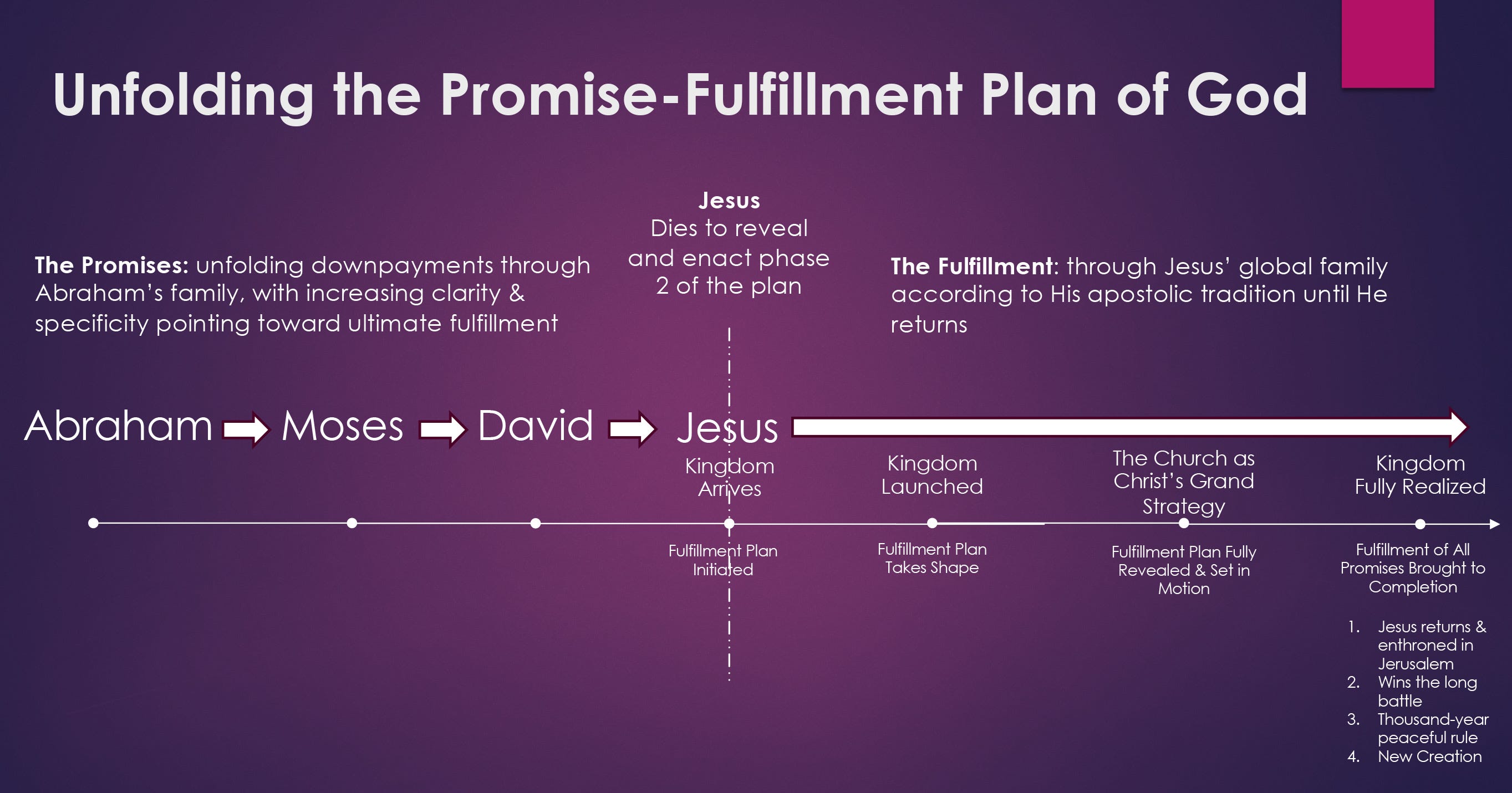
Understanding God’s overarching story, allows us to see His plan and purposes being carried out across human history, from Abraham, until our time and beyond. It helps clarify the gospel as the proclamation that all God had been doing through Israel was always intended to be concentrated into one man, the Faithful Israelite, who introduced a new and living way (a whole new family, a new reality, a new paradigm) which Israel had not anticipated. Seeing how this new plan was initiated, took shape, and was set in motion, gives us the model for Christ’s Grand Strategy, which He put into effect and remains as His singular plan, until the time He returns and makes all things new.
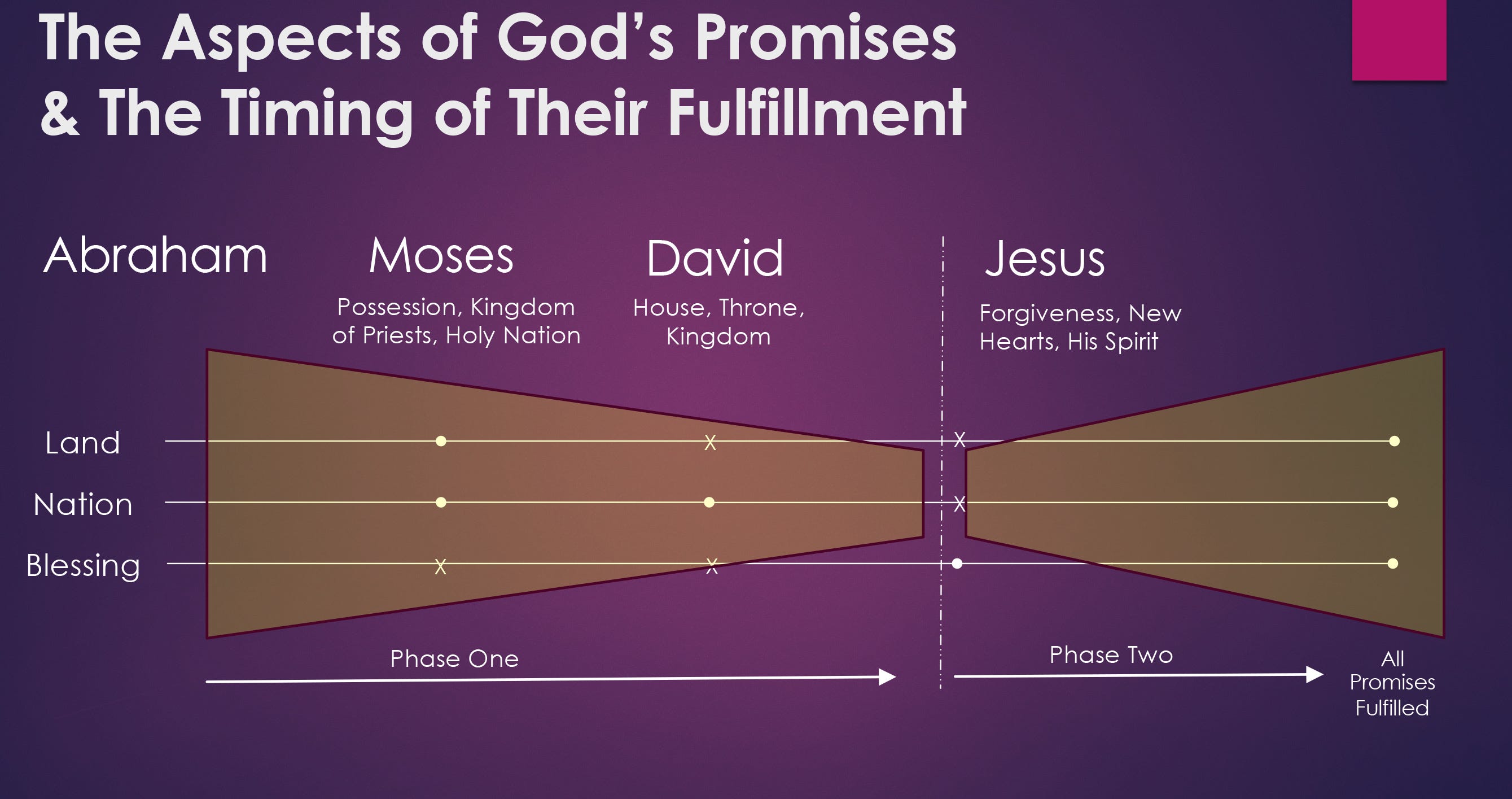
Once you understand the promises made to Abraham, Moses and David, and how the aspects of each of those promises have both already-and-not-yet components, it becomes clear how God’s story reveals the narrowing down of human faithfulness to one man, Jesus, who died and was planted in the ground, and out of which a whole new family sprung up and is growing, filling the whole earth. This sets a timeline for when the promises will be fully brought to completion, and it reveals the social structure of the church… household, family, commonwealth. Jesus’ Spirit is shaping a global family movement around a specific plan, and a specific set of patterns, principles and processes.
This term refers to the new community that Jesus built, made up of the disciples and those around them after His ascension (in Acts 1), and the communities— churches— that eventually multiplied across the Roman Empire; they were kerygmatic in the sense that they were commissioned to continue the proclamation to the entire world.
In Acts, Luke writes so that we can understand the plan of Christ, how it unfolded, and the patterns Jesus expects us to follow, in order to see His family continue to spontaneously expand and multiply; specifically, living as kerygmatic communities, organizing themselves as clusters and networks, and participating with apostolic teams.
One example of this from Cahn’s book, The Dragon’s Prophecy, is the idea that the modern-day Palestinians are a “resurrected” Philistine people and that to understand biblical prophecy, you must make that association. He likewise talks about the “resurrection” of the nation of Israel from being scattered, to reclaiming the land. The difference being that there remain verifiable ethnic Jews to this day, who claim rights to the land of Israel, while no ethnic Philistines have been located. Via DNA testing on Philistine remains, it seems clear that the ethnically Philistine people originated somewhere in Europe, while the modern-day Palestinians are ethnically Arab and originate from that region. After the Jewish-Roman wars of the first and second century, the Romans began to refer to the area as Syria Palaestina (from the word Philistine) not because it was populated by ethnic Philistines, but because they did not want the land to be identified with the Jewish people. https://www.npr.org/2019/07/03/738586883/dna-study-reveals-philistines-were-originally-from-europe
Their authority is based in their clear understanding and culturally flexible use of the gospel and the apostolic teaching, and is evident in their commitment (working harder, suffering more, daily facing opposition and living with the daily pressure of the churches – all with no reward). Their credentials are the networks of churches and teams they are shaping, who share in their stewardship via strong, strategic connections. They show clear evidence of their calling (gifting, faithful stewardship, expanding their fields). They speak frankly and plainly, not eloquently, a “weakness” which is sometimes exploited by “professional” religious leaders who boast about their own “successes & achievements” (cultural cache) or exhibit more personal charisma (personality cult). Apostolic leaders are disruptors, using plain, frank speech and powerful arguments based in Paul’s letters, they are often confrontational and willing to cut off churches from false leaders.
This is the best translation of the term Paul uses in Ephesians 3:10 when he states that one of his two job descriptions is to bring to light Christ's administration or plan for the kingdom, which is the Church; the best translation for this Greek term (a word combining house and law) is His plan, but clearly refers to His big, grand plan—His grand strategy for unfolding His kingdom.
The belief that truth and knowledge are malleable, and exist only as representations of the power dynamics between dominant and oppressed groups
Postmodernism is probably best understood as a rejection of and deconstruction of modernism with all its systems and values, but has yet to emerge as a well-defined philosophy of its own beyond this.